Demolition by Neglect
The Engineered Collapse of the Sherman School
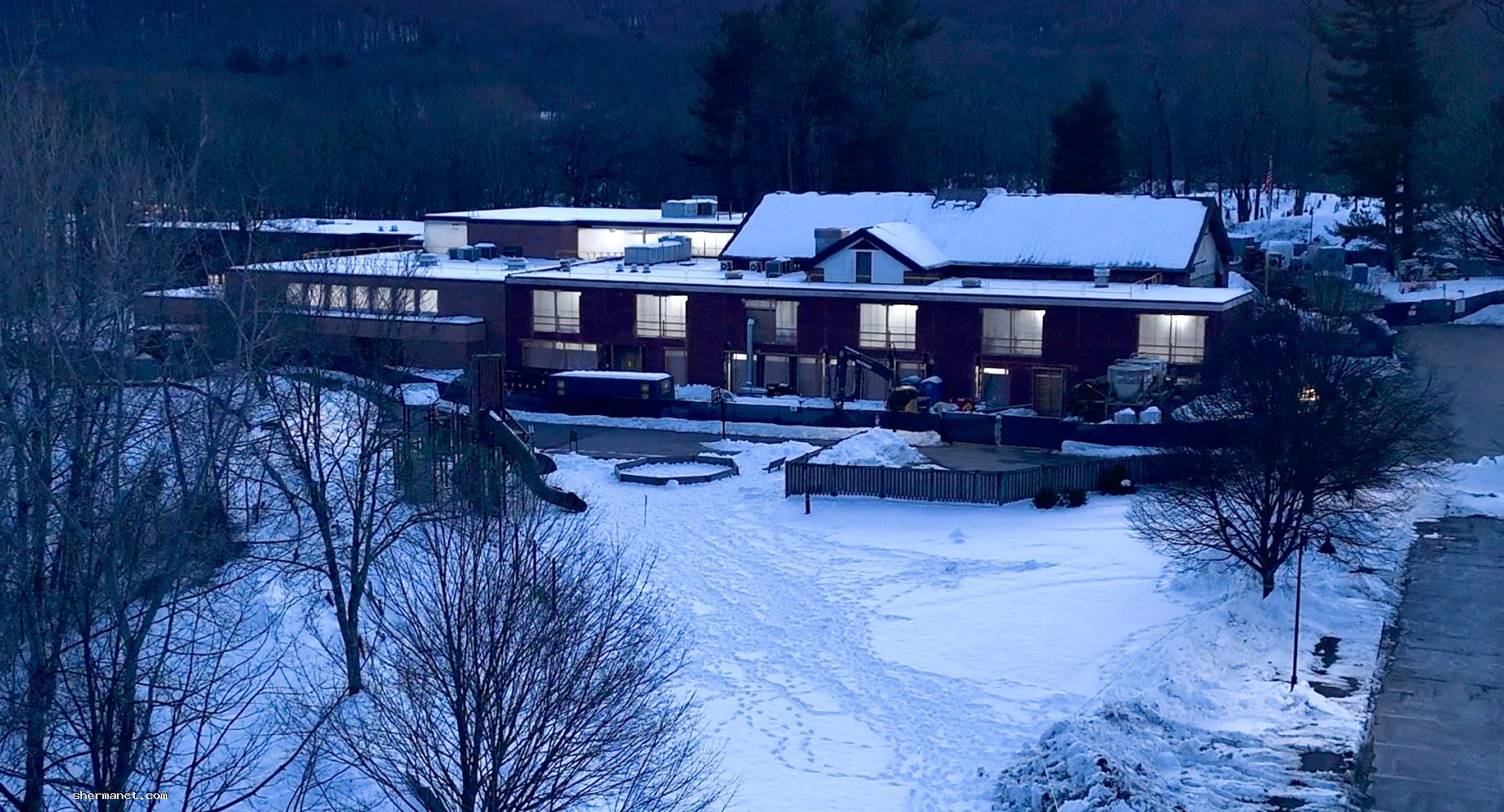
Imagine entrusting your home to a caretaker for a year. You leave them with a single directive and a steady stream of checks to cover the roof, the boiler, and the winterizing. Month after month, the caretaker returns the money uncashed, assuring you the estate is pristine.
A year later, you turn the key. The pipes have burst, the furnace is dead, and the winter wind is howling through open windows. Horrified, you realize the caretaker didn't just fail to maintain your greatest asset—they actively orchestrated its ruin by withholding the very funds you provided to save it.
This is not a hypothetical parable of betrayal. It is the exact blueprint of how the Town of Sherman and its Board of Education systematically dismantled the taxpayers’ most valuable asset.
The Phantom Budgets
When Sherman voters entered the booths to authorize a $42.8 million renovation for the local school, the mood was not one of civic triumph. It was the grim resignation of a hostage. The town did not approve the largest debt package in its history out of enthusiasm; they capitulated because the building was crumbling around their children. They were told there was no other choice.
But brick-and-mortar institutions do not collapse overnight. Structural ruin on a multi-million-dollar scale requires years of deliberate, calculated attrition. In urban planning, it is a tactic known as Demolition by Neglect.
A forensic examination of town ledgers reveals a disturbing decade-long pattern of what can only be described as "phantom budgets." Year after year, taxpayers dutifully authorized massive appropriations for the Board of Education, trusting those funds would patch roofs and upgrade aging infrastructure. But when the fiscal year closed, those checks were quietly handed back.
The Ledger of Betrayal
To understand how the school fell into such catastrophic disrepair, one only needs to look at the money the town was given, versus the money they actually spent on the building:
- Fiscal Year 2013/2014: Taxpayers authorized $8,852,260. The BOE only spent $8,757,269.
Withheld from the school: $94,991 - Fiscal Year 2015/2016: Taxpayers authorized $9,298,106. The BOE only spent $8,634,343.
Withheld from the school: $663,763 - Fiscal Year 2016/2017: Taxpayers authorized $9,381,718. The town ledger recorded an actual spend of only $6,725,287.
Withheld from the school: $2,656,431 - Fiscal Year 2017/2018: Taxpayers authorized $9,381,405. The BOE only spent $8,725,195.
Withheld from the school: $656,210 - Fiscal Year 2019/2020: Taxpayers authorized $9,380,779. The BOE only spent $8,932,753.
Withheld from the school: $448,026 - Fiscal Year 2021/2022: Taxpayers authorized $9,319,821. The BOE only spent $8,851,274.
Withheld from the school: $468,547
This was not a one-time accounting error. A review of these municipal budgets reveals that the Board of Education and Town Hall executed this maneuver in at least six different fiscal cycles over the last decade. Even if one conservatively removes the massive $2.6 million anomaly in 2016/2017, the administration still starved the school of over $2.3 million in authorized taxpayer funds in the years leading up to the referendum.
The money was always there. The taxpayers paid it. The administration just refused to spend it on the building—absorbing it back into the town's General Fund surplus to artificially inflate their own balance sheets.
The Architect at the Helm
When confronted with this staggering ledger of neglect, the administration’s defenders will inevitably point to a legal technicality: under Connecticut law, the Board of Education has statutory autonomy over its own expenditures. They will argue that First Selectman Don Lowe could not legally force the BOE to spend the authorized funds on a failing roof.
While technically true, it is an abdication of executive leadership. First Selectman Don Lowe was not a passive bystander in this engineered collapse; he was the town's chief executive and its loudest megaphone. If a true leader sees a rogue board returning a half-million dollars a year while the town’s most valuable asset rots from the inside out, they sound the alarm. They call joint meetings. They rally the taxpayers and demand accountability.
Don Lowe did none of those things. Instead, he quietly accepted the unspent money.
At the end of every fiscal year, unspent BOE funds lapse directly back into the town’s General Fund—the very surplus managed by the First Selectman. Lowe gladly absorbed those millions to artificially inflate the town’s savings. A bloated General Fund allowed his administration to suppress the mill rate, project the illusion of fiscal brilliance, and quietly fund massive administrative pay raises—all while the school deteriorated.
Lowe used the BOE's legal autonomy as a shield while pocketing the financial benefits of their neglect. He didn't just allow the decay; he monetized it for his own political capital.
The Extortion Racket
This is the apex of political leverage. By starving the facility of essential upkeep and hoarding the money taxpayers had already earmarked for its survival, the administration ensured the building would visibly, unavoidably rot. They engineered a catastrophe, backing the voters into an impossible corner.
Once the decay reached a critical mass, the architects of that neglect stepped up to the town meeting podiums to play the savior. They pointed to the failing infrastructure they had actively starved of funding, and framed the $42.8 million overhaul as the only moral choice left to protect the town's students.
It was a brilliantly disguised extortion racket. Now, the bill for that manufactured crisis has come due.
The Myth of the "Flat" Mill Rate
For years, Don Lowe’s singular political shield has been a simple, repetitive claim: "I didn't raise your taxes." Today, that claim is mathematically dead.
The financial shockwave of this engineered collapse has finally hit the municipal ledger. Sherman is now staring down an $848,641 annual interest payment purely to service the initial school bonds. You cannot drop a $42.8 million anvil on a town of 3,500 people and claim taxes aren't going up.
To avoid the political fallout of a massive tax hike, Lowe is currently proposing a $460,000 raid on the town’s emergency savings just to keep the mill rate artificially flat for one more cycle. He is bankrupting the town's savings to hide the cost of his own vanity project. But emergency funds eventually run dry. A historic tax spike is no longer a possibility; it is an absolute mathematical certainty.
The Cost of the Savior Complex
Sherman is not shouldering a $42.8 million burden because its school was simply "too old." Sherman is paying $42.8 million because its leadership understands a cynical truth of modern politics: quietly replacing a boiler wins you no legacy, but "saving" a condemned school builds you a monument.
If a caretaker actively orchestrated the ruin of your home, you wouldn't reward them with a multi-million-dollar renovation budget. You would fire them. But in Sherman, the architects of this collapse weren't fired. They were handed the keys to a brand new $42.8 million estate, and left the taxpayers to foot the bill.