The Cobbler Who Forged a Nation
Roger Sherman’s Unmatched American Legacy
How a self-taught shoemaker from Connecticut saved the Constitutional Convention—and secured the Union that would eventually end slavery.

Contents
When the architects of the American republic gathered in Philadelphia, they were largely a collection of aristocratic planters, wealthy merchants, and formally educated legal scholars. And then there was Roger Sherman.
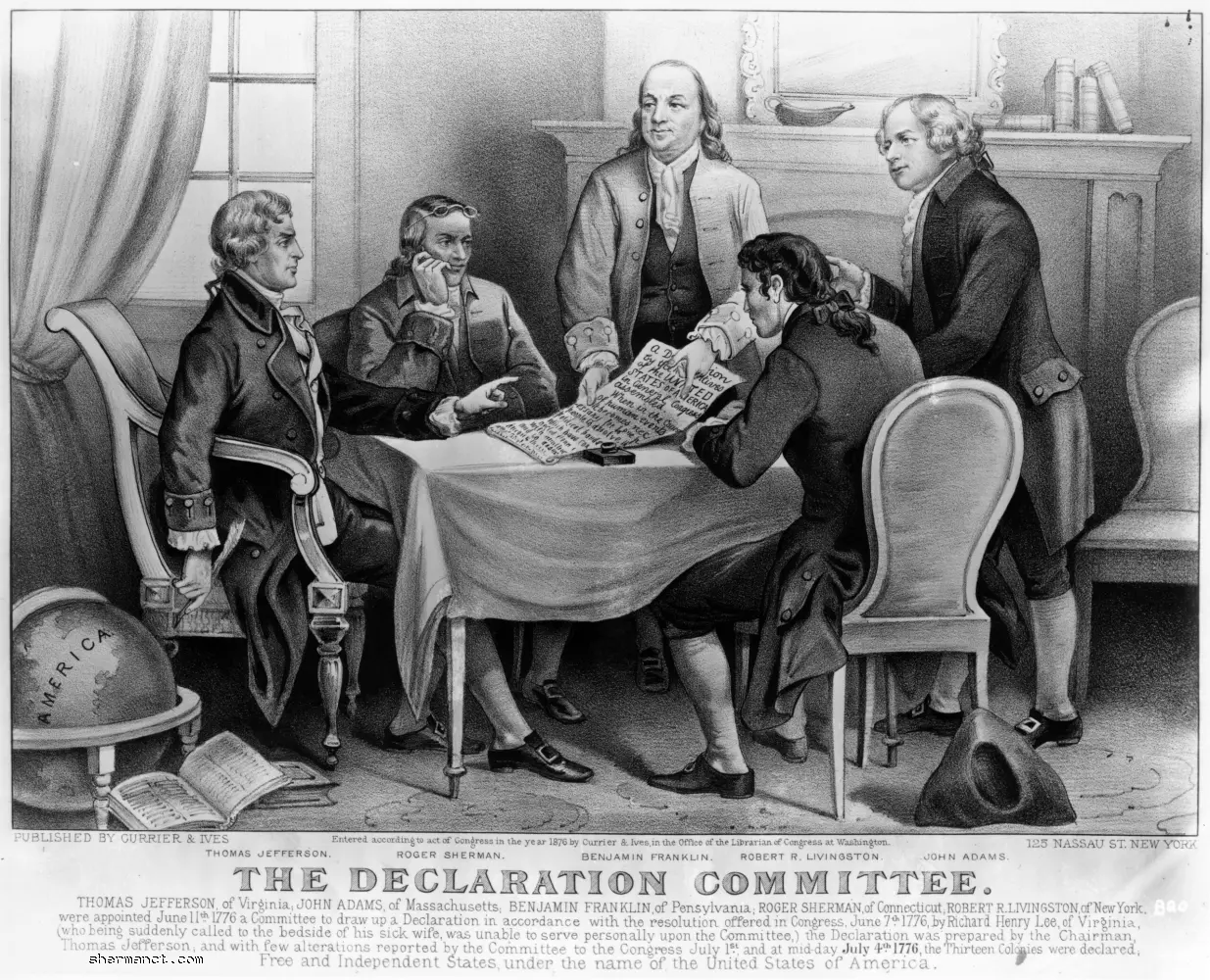
He was a man who arrived in Connecticut as a humble shoemaker, yet he would leave behind a legacy unmatched by George Washington, Thomas Jefferson, or Alexander Hamilton. In the sprawling, mythologized pantheon of the Founding Fathers, Sherman stands alone in one staggering historical achievement: he is the only person to sign all four of the foundational state papers of the United States—the Continental Association, the Declaration of Independence, the Articles of Confederation, and the United States Constitution.
For the town of Sherman, Connecticut, which proudly bears his name, his story is not merely a chapter of local history. It is the story of the quiet, pragmatic engine that made the United States possible.
From the Cobbler’s Bench to the Bar
Born in Newton, Massachusetts, in 1721 to a family of farmers, Sherman’s early life offered little indication of his future prominence. His formal education was practically nonexistent, ending at the local grammar school. He spent his youth at a cobbler’s bench, learning the painstaking trade of making shoes.
But Sherman possessed a ravenous intellect. Guided by his father’s library and the mentorship of a Harvard-educated parish minister, he absorbed knowledge wherever he could find it. Following his father’s death in 1743, a 22-year-old Sherman packed up his tools and moved with his family to New Milford, Connecticut. There, he and his brother opened the town’s first general store.
It was in the rugged hills of Litchfield County—specifically New Milford and its northern parish, which would eventually break away and bear his name in 1802—that Sherman truly forged his identity and transformed from a tradesman into a polymath. He didn't just tend the store; he secured a post as the county surveyor in 1745, trekking across the untamed Connecticut landscape. The income allowed him to purchase vast tracts of local land, deeply rooting him in the community. He immersed himself in town affairs, eventually becoming the town clerk and a trusted local leader.
It was here, in the quiet isolation of early Connecticut, that his intellectual pursuits flourished. He began publishing his popular astronomical calculations in a series of almanacs and taught himself the law by candlelight. In 1754, despite having never set foot in a university lecture hall, he passed the Litchfield bar. Sherman quickly ascended the ranks of Connecticut’s civic life, serving in the state’s House of Representatives, sitting as a Justice of the Superior Court for over two decades, and eventually becoming the first Mayor of New Haven.
The Architect of Compromise
History often remembers the soaring rhetoric of the Revolution, but nation-building requires more than eloquence; it requires parliamentary grit. By the time Sherman arrived at the Constitutional Convention in Philadelphia in 1787, he was 66 years old—the second-oldest delegate in the room, junior only to Benjamin Franklin.
He was famously described as a "terse, ineloquent speaker." He did not write soaring Federalist Papers or give fiery speeches to the masses. Instead, Sherman worked the floor. He made or seconded 160 motions during the convention, emerging as a fierce and formidable opponent to James Madison.
The convention nearly collapsed over the issue of representation. Large states, backing Madison’s Virginia Plan, demanded that legislative power be based strictly on population. Small states pushed the New Jersey Plan, demanding equal votes for every state. The deadlock threatened to doom the young nation before it truly began.
It was Sherman, alongside Oliver Ellsworth, who brokered the salvation of the convention: The Connecticut Compromise.
Sherman proposed a brilliant, pragmatic middle ground. The legislature would be split in two. The lower chamber (the House of Representatives) would represent the people proportionally, satisfying the large states. The upper chamber (the Senate) would grant two seats to every state regardless of size, protecting the smaller states. It was a structural masterpiece that remains the foundation of the United States Congress today.
Saving the Union to End Slavery
Perhaps Sherman's most profound historical impact lies in a deeply uncomfortable paradox regarding the great moral failing of the era: slavery. Sherman was personally opposed to the institution, guided by his strict Puritan faith. Yet, as he surveyed the fracturing convention hall in 1787, he faced an impossible calculus.
He recognized a chilling geopolitical reality. If the Constitutional Convention collapsed over the issue of abolition, the Southern slave-owning states would simply walk away. They would have formed their own sovereign confederacy, free to expand their slave empire indefinitely, completely insulated from the political and economic pressures of the North.
Sherman chose to swallow a bitter pill. He championed compromises that kept the Southern states in the fold, believing that holding the fragile country together was the paramount objective. By keeping the South tethered to the North, Sherman inadvertently secured slavery’s eventual destruction. He bound the Southern slave economy to a unified federal government that, seven decades later, would grow strong enough to dismantle the institution by force. Without Sherman’s calculated pragmatism in 1787, there might have been no United States to fight the Civil War in 1861.
A Connecticut Colossus
After ratification, Sherman’s service to his country did not cease. He was elected to the First Congress as a U.S. Representative from Connecticut's at-large district, and subsequently served in the United States Senate until his death. In July of 1793, at the age of 72, Sherman succumbed to typhoid fever in New Haven, where he is buried today.
Today, the town of Sherman stands as a living monument to a man who built a nation the same way he once built shoes: with careful measurement, tough materials, and an unrelenting focus on utility. Roger Sherman was not the most glamorous of the Founding Fathers, but when the American experiment teetered on the brink of collapse, it was the cobbler from Connecticut who stitched it together.