The $50 Million Ghost Ship
A Megaproject Without a Paper Trail
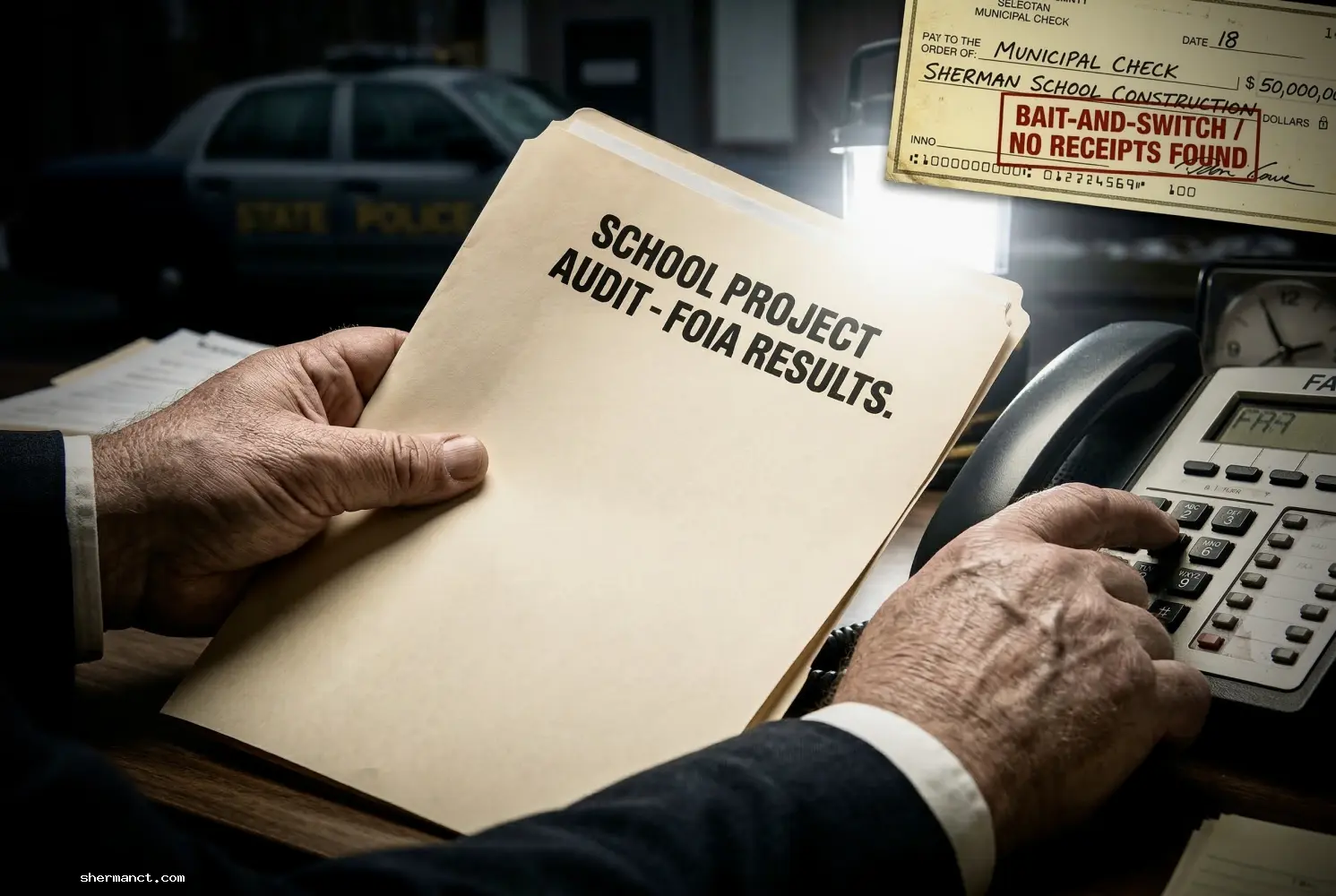
There is a specific, terrifying velocity to the expenditure of fifty million dollars. The Sherman School project was initially sold to taxpayers as a staggering but "necessary" $42.8 million burden. However, that figure was merely the opening bid. Before a single shovel even hit the dirt, the administration's initial financial forecasting collapsed. Blaming higher-than-expected bids, they returned to the taxpayers in the dead of August, peak vacation season, demanding an additional $6.5 million just to get the project off the ground.
When a municipality crosses the $50 million threshold before construction even begins, the fundamental social contract of government is invoked: if you demand the money, you must produce the receipts.
The Anatomy of an Empty Folder
At the eleventh hour, prior to publication, Building Committee representative Kerry Merkel reached out to "clarify" the administration's position. Apparently feeling the pressure of the impending report, Merkel attempted a clumsy "correction" of the press, delivering a lecture on accuracy that can only be described as a masterclass in bureaucratic contradiction. She wrote: "If you are going to continue to publish your articles as a journalist, I encourage you to be more precise in recounting prior communications and events."
It is a bold strategy to lecture a journalist on precision when your own narrative is dissolving in real time. In the interest of that requested precision, let us look at the written record of Merkel’s shifting reality. On March 10, Merkel issued a flat, unequivocal denial regarding the existence of site logs: "As for daily reports or logs, those are not something the Building Committee creates... we do not have anything to provide."
The "precision" Merkel demands apparently requires a journalist to be clairvoyant. At no point did the administration concede these logs existed until they were pressed for comment on an article exposing their absence. Only then, staring down the optics of a $50 million megaproject lacking a paper trail, did Merkel execute a bureaucratic magic trick. The "non-existent" logs abruptly materialized, only to be immediately concealed behind a manufactured "safety and security" review.


The paradox is staggering: In her rush to prove the press "inaccurate," Merkel confessed that her own prior FOIA denial was entirely false. To lecture a reporter on precision while simultaneously reversing a formal legal denial is more than just irony, it is the defining hallmark of profound mismanagement. Entrenched in the reflexive production of administrative denials, Merkel seems oblivious to the fact that she has codified her own contradictions into the public record.
By the 5:00 PM deadline on March 16, the Building Committee had failed to produce a single statutory justification for hiding these newly-minted documents. They have no ledger, they have no logic, and, judging by Merkel's correspondence, they have lost control of their own narrative. They are simply propping up the facades of a $50 million ghost ship.
The Missing FOIA Paper Trail
- The Tarp Crisis: There are no robust email chains to a satisfying degree detailing the tarp crisis or the roof leaks.
- Financial Fallout: Merkel clarified that there are "none [no Proposed Change Orders] related to your request." This means the administration claims there is zero financial paperwork generated by the recent weather damage and emergency mitigation.
- Historical Neglect: The paper trail regarding deferred maintenance requests from 2018-2022 is disturbingly lacking.
- The "Security" Shield: Merkel stated the committee "does not create daily logs," but relies on the construction manager, Newfield. Alarmingly, she admitted the logs are currently being withheld, stating they are "under review for safety and security purposes with legal counsel."
Let’s be exceptionally clear about what this means. A daily construction log is a standard financial ledger of labor, weather conditions, and material deliveries. It is not a state secret. To claim that a town's construction ledger must be hidden from a journalist "for safety and security purposes" is an absurd, transparent abuse of the FOIA statute.
Viewed through the lens of this staggering administrative secrecy, the events of recent weeks snap into jarring focus. When an administration lacks a transparent paper trail for a $50 million megaproject, and hides the logs they do have behind "safety and security", oversight is no longer viewed as a democratic process. It is viewed as an existential threat.
The further I dig into this project and the characters involved, the more I find myself in disbelief over the profound lack of operational control guiding it. It is not just that a $50 million project appears too large for them to manage, but that basic professional interactions are treated as crises. Few incidents give me a better purview of how this administration operates under pressure than my experience after publishing the dreadful conditions of the school construction site on February 9, followed immediately by my encounter at Town Hall on February 11.
The Morning Pantomime: February 11
On the morning of February 11, shortly after Sherman CT News published legally obtained drone footage documenting the tarp-covered reality of the school roof, the administration's panic manifested physically.
At 10:15 a.m., a State Trooper was sitting in my driveway. When I walked out to speak with him, he abruptly drove off, relocating to the nearby park. I followed, walking my dog. As I approached his vehicle, he rolled down his window, stated he was "on the phone and will be a minute," and pulled away again. After returning my dog to the house, I walked toward the trooper a third time. Again, he pulled away.
It was an absurd municipal pantomime, a state law enforcement asset playing a slow-motion game of hide-and-seek. Frustrated, I told my 80-year-old husband it was time to go directly to the source. We drove to Town Hall.
We found the trooper's vehicle parked directly in front of First Selectman Don Lowe’s office. We stood calmly by the passenger side door. The window remained up. Eventually, it rolled down. "I'm on the phone and will be a minute," he repeated, and the window rolled back up. Finally, minutes later, he lowered the glass and asked, "Would you like to come and speak in my office?"
During a half-hour conversation, the trooper claimed he had been parked at my home to "protect our driveway." Yet, in the same breath, he admitted that he was one of three individuals who had called the FAA on me out of concern for "safety and security", despite explicitly acknowledging that no rules, ordinances, or laws were violated during the flight.
We shook hands. But the reality was clear: emergency dispatch had been weaponized to chill a journalistic investigation. I turned to my husband. It was time to speak with Don Lowe.
The February 11 Town Hall Interaction
We walked into Town Hall and encountered the First Selectman in the hallway. We were calm and polite. Lowe, however, became instantly and visibly irate at the mere sight of our presence.
I initiated the conversation regarding the blinding, industrial construction lights at the school site, an issue plaguing the neighborhood.
"Your lights on the school are in violation," I stated.
"No, they aren't," Lowe snapped. "We aren't doing anything about the lights and if anything, your lights are in violation."
Then, the First Selectman abruptly escalated the situation. Visibly agitated, he turned a quiet conversation about municipal zoning into a hostile confrontation.
"And furthermore, I feel threatened by your presence here. You threatened people, you harassed people, you did harm. I feel threatened by your presence right now and I want you to leave or I will call the police."
My husband, standing quietly beside me, replied: "We just spoke to the police."
"I don't care, I want you to leave," Lowe retorted. He turned his back and walked away.
Let’s pause and examine that specific accusation: threats, harassment, harm. At no point did any such actions take place. We were two residents standing calmly in a public building asking a standard zoning question. But "harm" is a highly calculated metric for a politician to invoke. When a municipal executive cannot defend their actions, they manufacture victimhood. By baselessly accusing a journalist of "harm," Lowe attempted to flip the script, desperately trying to reframe a demand for accountability as a personal attack.
As we exited Town Hall, I turned to my husband in disbelief. The real "harm" being done in Sherman is not a publisher asking questions about construction lights. The real harm is a chief executive who weaponizes emergency dispatch, hides a $50 million ledger, and manufactures police threats out of thin air to avoid doing his job.
The Cost of Incompetence
A few days ago, I drove to Town Hall to pick up a FOIA packet that had been left for me. As I was walking into the building, Don Lowe was walking out. He greeted me with an animated, cheerful "hi", a reaction so bizarrely disconnected from our last encounter that it seemed he didn't even recognize who I was.
I stopped him. "Hi, like you aren't even acknowledging what happened a week ago," I said. "You threatened to call the police on me."
His defense was baffling. "That was more than a week ago," he replied, as if an expiration date applies to intimidating a resident.
"You owe me an apology," I told him.
He immediately issued a brief, dismissive, "I'm sorry."
"That's not good enough," I replied. I turned and walked into Town Hall to collect my public records, and he walked away.
The Crosshairs of Accountability
In a recent public publication, Don Lowe attempted to reframe this escalating crisis. Addressing the town's volunteers, he wrote: "And your good faith efforts can sometimes put you in the crosshairs of critics, but don't be dismayed. Just keep doing your excellent work..."
It is a desperate, transparent deflection. The First Selectman is attempting to use the hard work of local volunteers as a human shield to deflect from his own administrative failures. He operates under the assumption that if he plays the victim, issues insincere hallway apologies, and frames demands for a $50 million paper trail as the petty grievances of "critics," the scrutiny will eventually fade. He assumes we will lighten up.
He fundamentally misunderstands the situation.
It is precisely his own unforced errors that guarantee this investigation will only dig deeper. When an administration calls the State Police to intimidate a journalist, weaponizes 911 over legal drone flights, violates First Amendment rights, and operates a $50 million megaproject without a ledger, they do not earn a reprieve. They invite a forensic audit.
The demand for transparency and accountability is not an attack on volunteers; it is the absolute baseline for a functioning democracy. This administration's lack of oversight is no longer just frustrating, it is a financial and civic liability. And if they believe their hostility will make us look away from this $50 million ghost ship, they are sorely mistaken. We are just getting started.
Support Independent Journalism
Investigative journalism and detailed municipal reporting require an immense amount of time and resources. From the initial background research and public records requests to the painstaking data illustration and editing, producing these articles is a full-time commitment. If you value this level of independent reporting, please consider supporting the effort. Whether it's a few bucks or a generous contribution, every donation helps keep this project running.