Sherman's Fiscal Failure
Paving Roads, Padding Salaries, and Sherman’s $50 Million Illusion
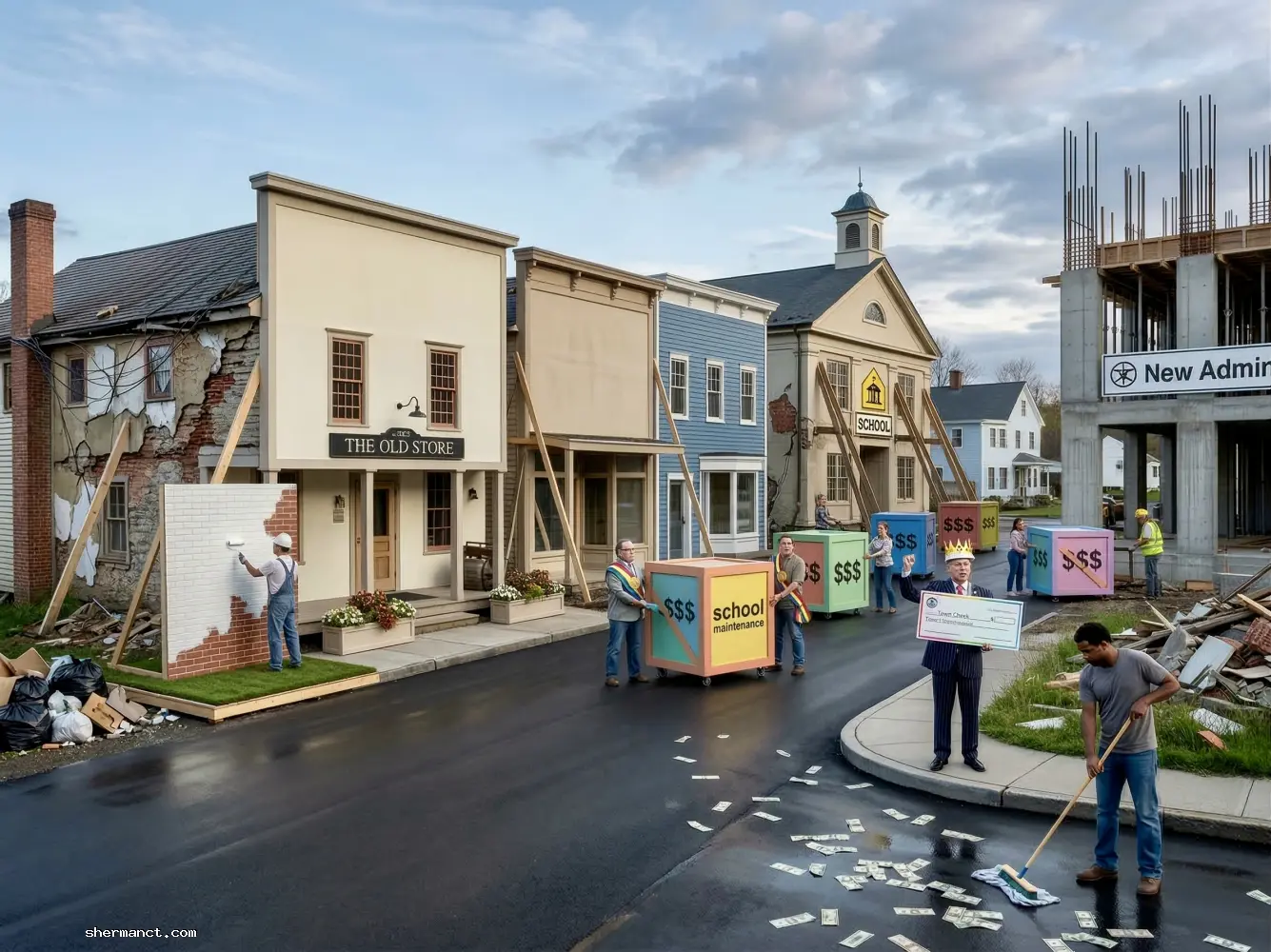
The collapse of the Sherman School and the resulting $50 million tax burden looks, at first glance, like a catastrophic administrative blind spot. It is easy to assume the Lowe administration was simply caught off guard when the roof started leaking and the K-Wing began to rot.
But a review of the Town of Sherman’s operating budgets from 2013 to 2026 suggests something much more deliberate. The decay of the Sherman School was the predictable result of a highly specific fiscal strategy: demolition by neglect.
Here is what the math reveals about the starving of Sherman’s most critical asset.
The Optics of Administration
Municipal failure happens when leadership prioritizes highly visible, cosmetic projects over the invisible, foundational rot of a primary school roof. When a government operates purely on perception rather than infrastructure, the resulting financial collapse is a mathematical certainty.
The Facilities Management Void
The most glaring anomaly in the town’s financial history is the sudden disappearance of the people responsible for keeping the buildings standing.
In the 2015/2016 budget, the town entirely defunded the $25,000 "Facilities Manager" line item. The position vanished. It did not reappear in any meaningful capacity until the 2021/2022 budget, and even then, it was tucked under the Emergency Services Facility (ESF) for a meager $5,076—explicitly not for general town or school maintenance. By the proposed 2025/2026 budget, this ESF management role is still funded at only $10,000.
For the exact decade during which the school’s infrastructure actively decayed to the point of a $50 million crisis, the town budgeted essentially zero dollars for dedicated municipal facility management. It is no coincidence that the K-Wing was shuttered in 2015, the same year the Facilities Manager was cut.
The Starvation of the School
While the buildings were left unmanaged, the Board of Education was placed on a financial starvation diet. During an inflationary decade where the costs of basic goods, services, and construction skyrocketed, the BOE budget was intentionally flatlined, and in some years, actively reduced:
- 2015/2016: $9,298,106
- 2020/2021: $9,380,589 (A decrease from the previous year)
- 2022/2023: $9,233,865 (Another decrease)
Maintaining a large municipal building during an inflationary period with a shrinking budget is an impossible metric. The administration wasn't holding the line on taxes. They were ensuring the school lacked the capital required to survive.
Paving Roads While the Roof Leaks
The budgets reveal a strategy focused entirely on optics over infrastructure. While the school deteriorated, the administration consistently funded highly visible public works projects.
Road maintenance jumped from $295,596 in 2017 to a proposed $325,000 in 2025. The budget rationales explicitly state that these funds were used to pave roads and beach parking lots. The administration made a calculated choice: they prioritized the smooth paving of the beach parking lot while ignoring the failing roof over the town's children.
The February 11 Town Hall Interaction
When Sherman CT News pointed a camera at the site on February 11, documenting the tarp-covered roof, the administration's panic manifested physically. After a bizarre series of interactions with a State Trooper in my own driveway, we went to Town Hall to seek answers. First Selectman Don Lowe abruptly escalated a quiet conversation about municipal zoning into a hostile confrontation:
"And furthermore, I feel threatened by your presence here. You threatened people, you harassed people, you did harm. I feel threatened by your presence right now and I want you to leave or I will call the police."
Let’s examine that accusation: threats, harassment, harm. At no point did any such actions take place. We were two residents standing calmly in a public building asking a standard zoning question. But "harm" is a highly calculated metric for a politician to invoke. Unable to defend his actions, Lowe manufactured victimhood. By baselessly accusing a journalist of "harm," he attempted to flip the script, desperately reframing a demand for accountability as a personal attack.
As we exited Town Hall, I turned to my husband in disbelief. The real harm being done in Sherman is not a publisher asking questions. The real harm is a chief executive who weaponizes emergency dispatch, hides a $50 million ledger, and manufactures police threats out of thin air to avoid answering questions.
The Executive Reward
The audit also reveals how the chief executive was compensated while the town's infrastructure collapsed.
In a public appeal to voters, First Selectman Don Lowe attempted to frame his role as a financial sacrifice, claiming: "Believe me, I can make more money doing many other things than working 60 hours a week on a Sherman First Selectman salary – by the way, among the worst salaries of Town CEO's in the 169 Connecticut towns."
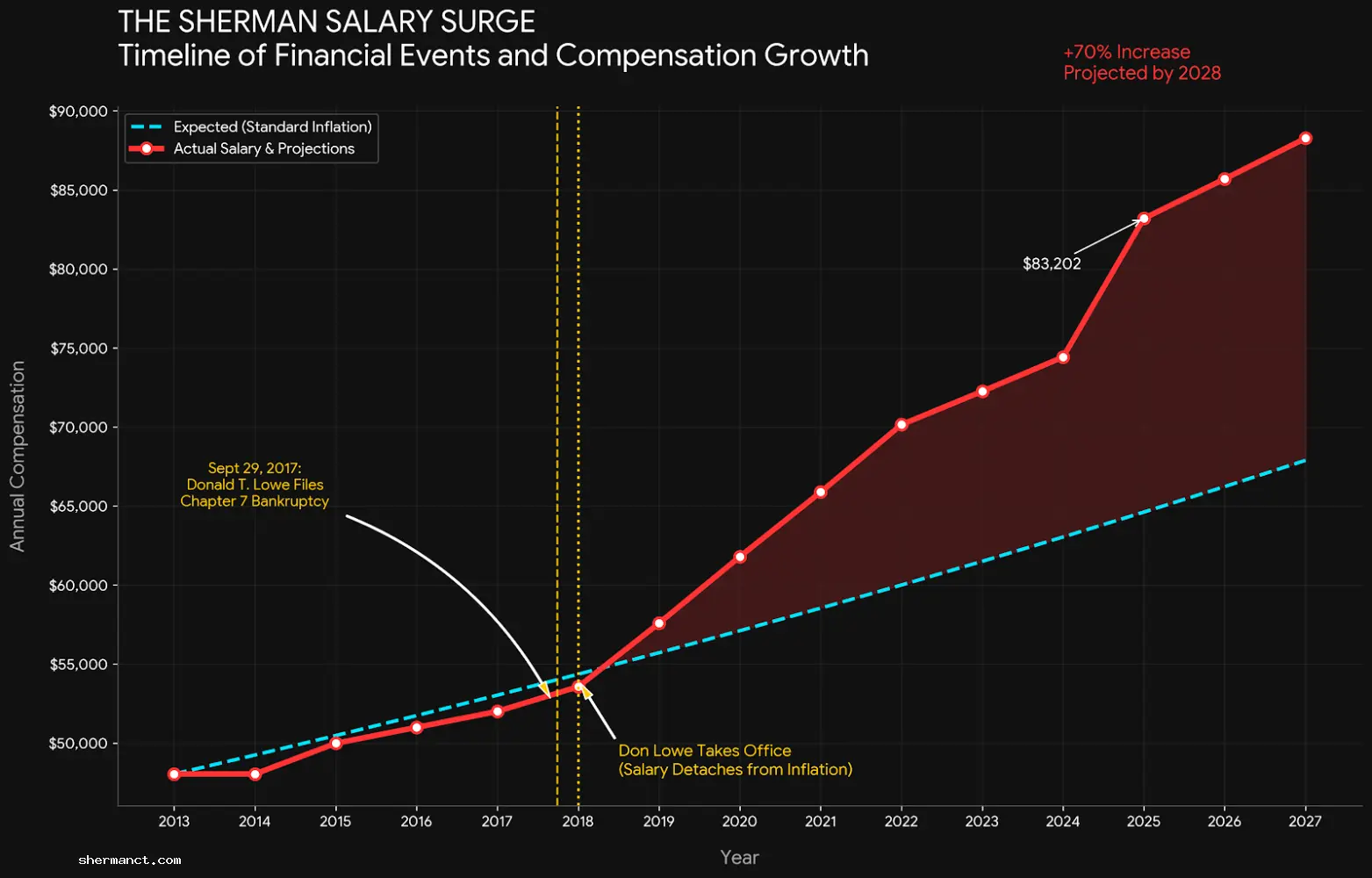
The public record tells a different story. As illustrated in the chart above, the First Selectman’s compensation violently detached from the standard rate of inflation starting in 2018.
- 2015/2016: $49,988
- 2021/2022: $65,882 (Noting a 7% adjustment to "align with area census")
- 2025/2026 (Proposed): $83,202 (With a planned bump to $89,000 in early 2026)
From 2015 to the proposed 2026 rate, the First Selectman’s salary increased by roughly 78%. While the school was starved of maintenance funds, executive compensation was aggressively increased, shifting the financial burden directly onto the Sherman taxpayers.
The Hidden Ledger
The budgets confirm that from 2015 to 2025, the administration systematically moved half a million dollars annually out of the operating budget and hoarded it in a "Reserve for Capital Exp".
They had the liquidity to address the $9.7 million K-Wing repair plan identified in 2021. They had the money to fix the roof. Instead, they chose to hoard a $2.3 million surplus, let the building fail entirely, and drop a massive, bonded $50 million megaproject squarely onto the backs of the taxpayers.
When viewed through the lens of this financial audit, the missing FOIA records and the weaponization of the state police finally make sense. The administration is scrambling to hide a decade-long failure of leadership.
Support Independent Journalism
Investigative journalism and detailed municipal reporting require an immense amount of time and resources. From the initial background research and public records requests to the painstaking data illustration and editing, producing these articles is a full-time commitment. If you value this level of independent reporting, please consider supporting the effort. Whether it's a few bucks or a generous contribution, every donation helps keep this project running.