Obfuscate, Spend, and Stonewall
Inside the administration's desperate, illegal scramble to hide the public ledgers on a $50 million debt bomb.

Administrative dysfunction rarely announces itself. It is usually discovered in the silence, in unreturned phone calls, blank ledgers, and the bureaucratic scramble that follows when taxpayers finally ask to see the math.
In the coming weeks, the Town of Sherman will ask its residents to step into a voting booth and approve an $18 million municipal budget. But as that referendum approaches, Town Hall has deployed a strategy of absolute evasion, violating state transparency laws by simply ignoring its statutory obligations.
The Stonewall: Constructive Denial and the $50 Million Black Box
The timeline of this evasion is a matter of public record.
It began on March 27, 2026, when this publication filed a formal Freedom of Information Act (FOIA) request seeking the foundational financial documents of the $50 million Sherman School renovation. We asked to review the digital ledgers and AIA Pay Applications to track specific line items, from technology packages to structural framing. The Town Finance Department acknowledged the request on April 1. Following that acknowledgment, communication ceased.
A municipality cannot legally go dark while managing fifty million dollars of the public's money.
A second, separate FOIA request was sent directly to First Selectman Don Lowe on April 2, seeking the IT vendor invoices and public records retention logs regarding the town’s severe 2019/2020 ransomware breach. In a clear violation of C.G.S. § 1-206(a), which dictates an acknowledgment within four business days, the First Selectman’s office ignored the request.
The refusal to produce IT records coincides with a disturbing shift in the town's security posture. While municipalities nationwide are actively targeted by ransomware syndicates, Sherman is not just hiding the autopsy of its past breach, it has actively dropped its cybersecurity insurance coverage.
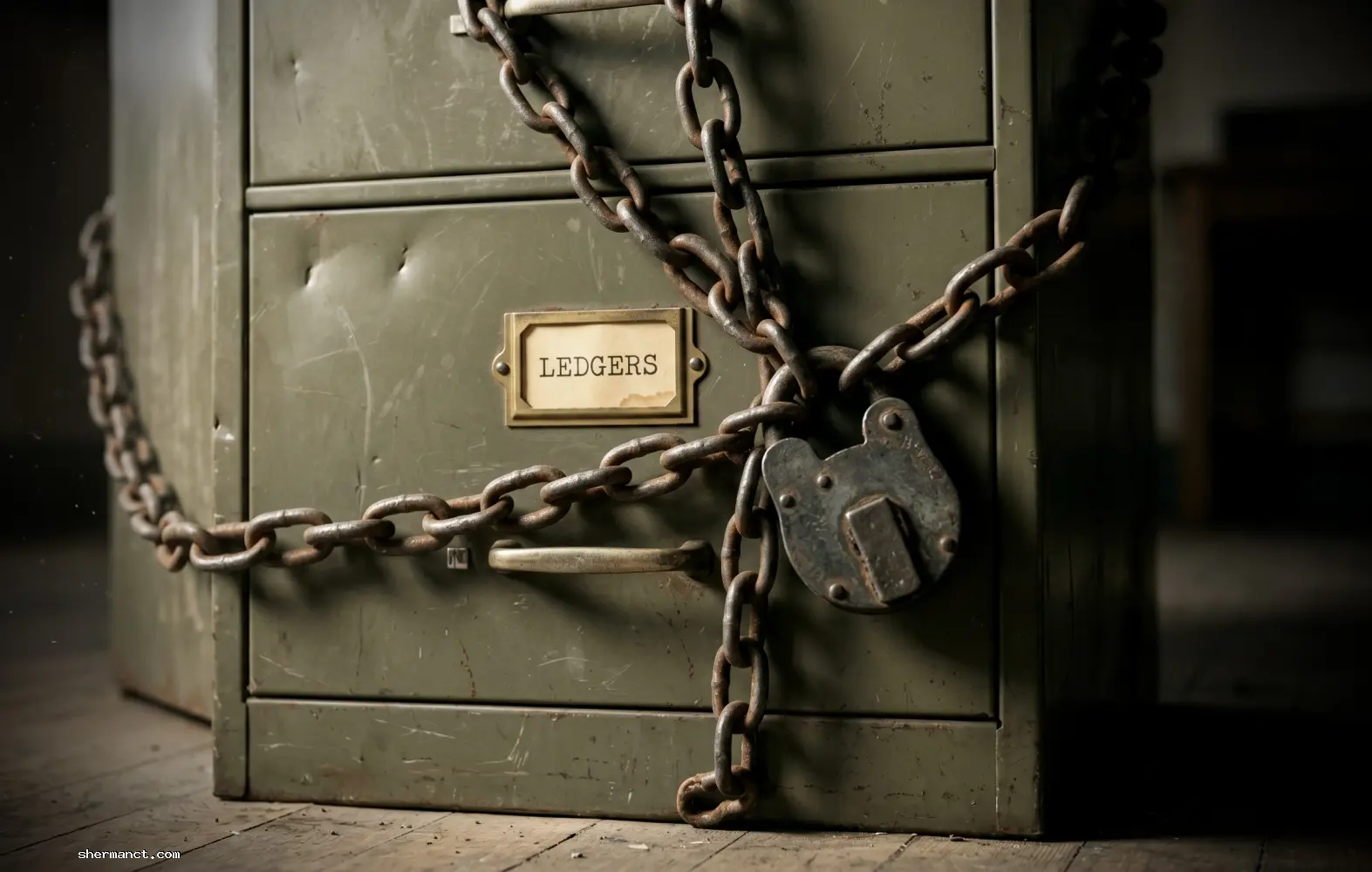
By April 14, formal demands for status updates on both the school construction ledgers and the cyber-breach records were met with continued silence. This is constructive denial, a calculated effort to withhold financial data from voters weeks before they are asked to approve a new budget.
On April 15, the local stonewall was bypassed. Two formal appeals were filed with the State of Connecticut Freedom of Information Commission (FOIC). Jurisdiction has shifted to Hartford. Silence is no longer a legally viable option.
A Fiscal Shell Game: Masking the Debt Horizon
Risking state intervention to hide public records suggests an administration with something to lose. A review of the upcoming budget provides the motive.
For years, the administration engaged in a pattern of deferred maintenance. By cutting facilities roles and allowing the Sherman School to physically deteriorate, the town artificially stockpiled cash. According to the audited statements for the fiscal year ending June 30, 2025, the liquid, unrestricted "Unassigned Fund Balance" sits at $5,642,924. Millions were hoarded while the town's primary educational asset rotted.
Today, the bill has arrived. The proposed 2026/2027 budget includes an $810,000 line item dedicated entirely to new debt service. To preempt a taxpayer revolt over this sudden spike, officials are executing a shell game. They are raiding those stockpiled savings, burning through $1.16 million in a single year, $660,000 from the General Fund and $500,000 from a Bond Premium, just to artificially suppress the mill rate.
Even with a million-dollar subsidy masking the true cost of historical negligence, the proposed budget still saddles residents with a 4.44 percent tax increase. That figure isn't a victory of fiscal conservatism; it is an illusion.
A Bond Premium is a one-time accounting maneuver. Once that $500,000 is spent, it vanishes. By relying on this short-term patch, the administration is engineering a fiscal cliff. Next year, to merely maintain the status quo, the town will be forced to drain the General Fund at an unsustainable rate or hit residents with a double-digit tax spike.
Executive Expansion vs. Public Austerity
While the town assumes historic new debt, executive compensation continues to climb. In the proposed budget, First Selectman Don Lowe secured a 7 percent salary increase for himself during a season where taxpayers are being asked to tighten their belts.
Over the past ten years, the First Selectman’s compensation has surged by 96 percent, far outpacing inflation and eclipsing the 4 percent raises allocated to his administrative staff.
While the executive branch secures its own raises, the new $50 million educational asset is facing deficits before the paint is dry. The proposed Board of Education operating budget is receiving a 0.63 percent increase. In an inflationary economy, this is a real-dollar cut, guaranteeing the new school will eventually fall right back into disrepair.
The Hubris of the Unaccountable
A municipality fails the moment its leadership treats transparency as an inconvenience and public funds as a private checking account.
The administration wants Sherman to step into a voting booth on May 2nd and blindly approve an $18 million budget. They expect the public to underwrite a structural deficit, finance a decade-long executive salary surge, accept the termination of cyber-insurance, and trust the stewardship of a government that refuses to produce the receipts for a $50 million bond.
They are selling a fiscal illusion built on hoarded cash, temporary premiums, and obstruction. But the state will eventually compel the town to open the books. When they do, the taxpayers will see exactly what this administration has been fighting to hide.
Support Independent Journalism
Investigative journalism and detailed municipal reporting require an immense amount of time and resources. From the initial background research and public records requests to the painstaking data illustration and editing, producing these articles is a full-time commitment. If you value this level of independent reporting, please consider supporting the effort. Whether it's a few bucks or a generous contribution, every donation helps keep this project running.