The 7% Selectman: What Sherman’s Glossy Budget Mailer Didn't Tell You
A forensic look at the town ledgers reveals hidden raises, phantom funds, and a $1.16 million illusion.
There is an implicit pact of precision when a municipal government asks its citizens to authorize nearly $18 million in public spending. This week, the Town of Sherman mailed a glossy, multi-page budget packet to every household, intended to serve as the definitive financial roadmap for the coming year. Yet, before the first page is even turned, a glaring anomaly presents itself right on the front cover. In the official return address, the administration managed to misspell the name of its own state as "Conencticut".
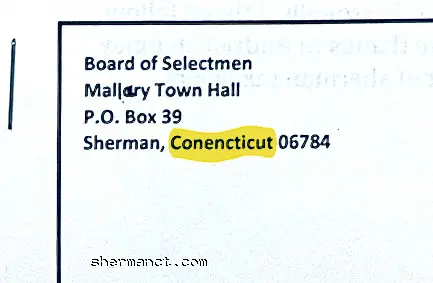
In isolation, a typographical error is easily forgiven. But as the preamble to an $18,029,340 budget, it begins to feel like a troubling metaphor. If the administration’s proofreading failed on the front cover, one has to wonder: what exactly is slipping through the cracks of the master ledger?
The Smoking Gun: A Decade of Self-Enrichment
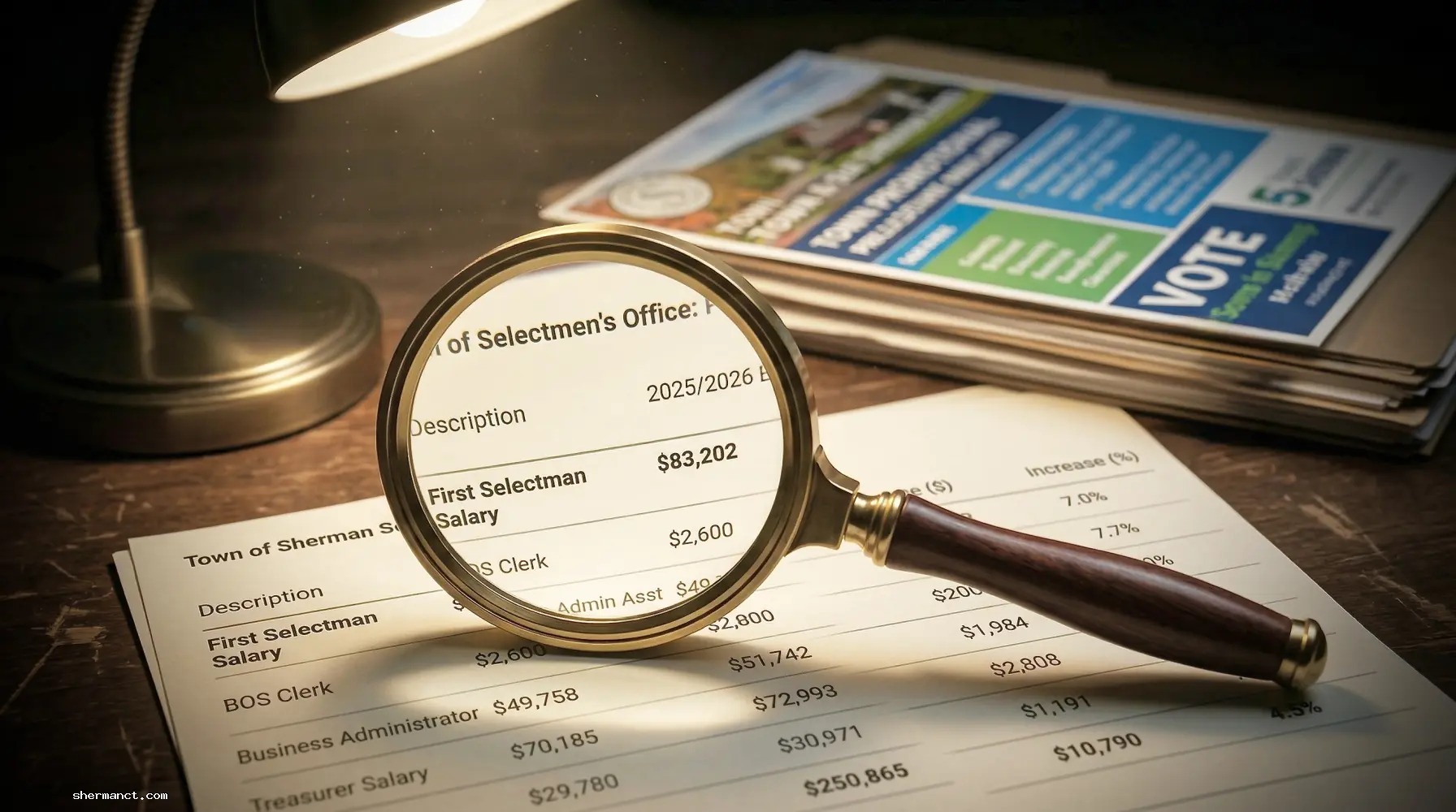
Turn deep into the line items, specifically Account 001-61, and a startling figure leaps off the page. First Selectman Don Lowe’s personal salary is quietly slated to jump from $83,202 to $89,000. That is a staggering 7.0% raise for the town's chief executive. But to grasp the true audacity of this figure, we must zoom out and examine the trajectory of the corner office over the last decade.
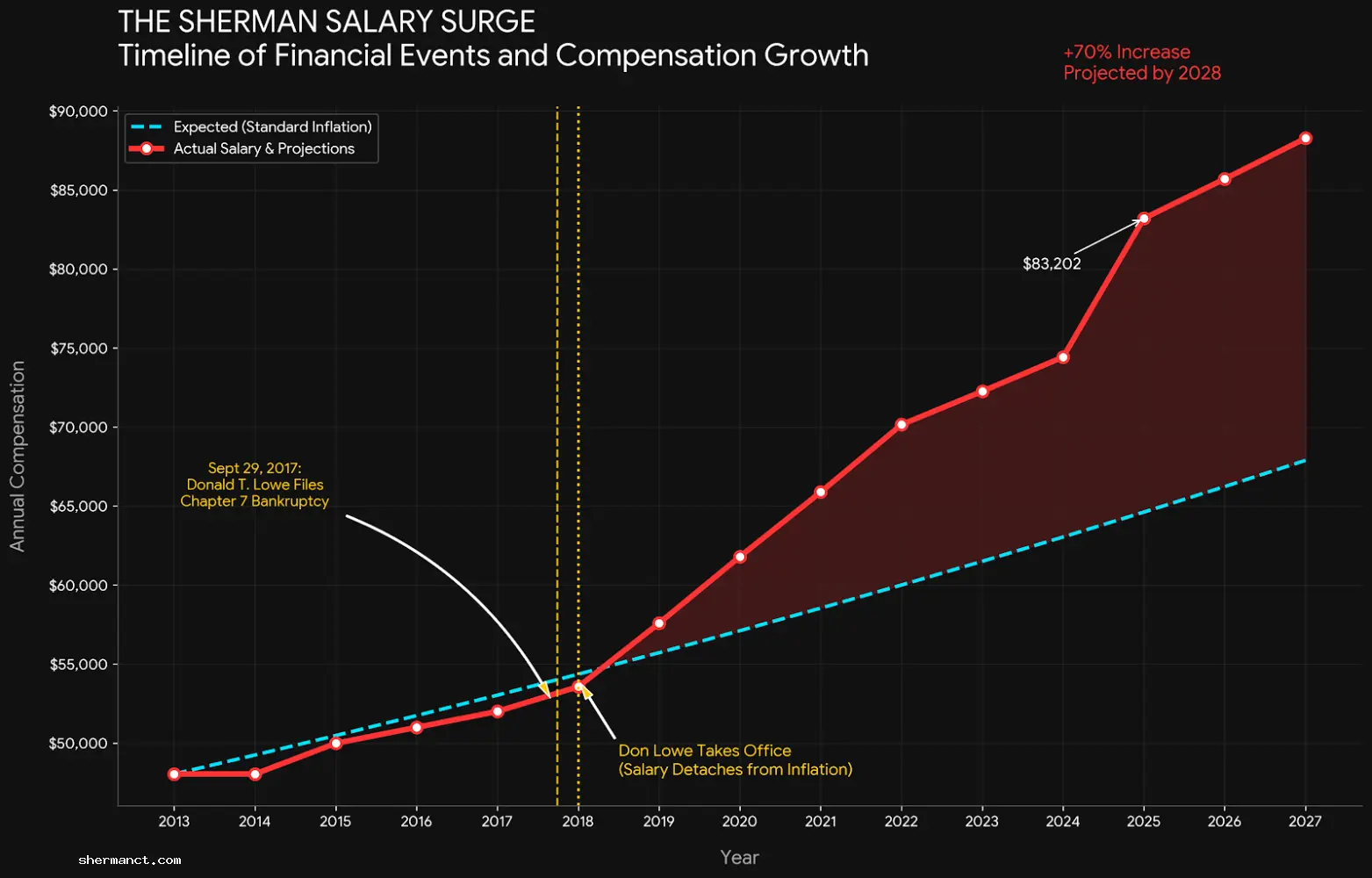
The historical data paints a vivid picture. For years, the First Selectman’s salary tracked predictably, tethered to a standard 2.5% inflation rate. Then came 2018. From the moment Mr. Lowe took office, executive compensation violently detached from economic reality, embarking on a steep, uninterrupted ascent. With this latest 7.0% bump, the office is now hurtling toward an unprecedented 96% total compensation increase by 2028.
When occasionally pressed on this staggering salary surge, the First Selectman has historically leaned on a familiar political defense: he suggests he could earn far more in the private sector, arguing that consistently raising the salary is essential to attract competitive talent to the position. It is a compelling narrative. But the documentary record tells a profoundly different story.
According to federal court records, just weeks before his initial 2017 election, Mr. Lowe, then an unemployed local musician, filed for personal Chapter 7 bankruptcy. The narrative that he walked away from lucrative private-sector wealth to serve the town appears to be a complete fabrication. Furthermore, the relentless inflation of the First Selectman’s salary over the last ten years has hardly resulted in a sudden influx of elite municipal managers vying for the seat. There is no fierce competition driving up the market rate for this position.
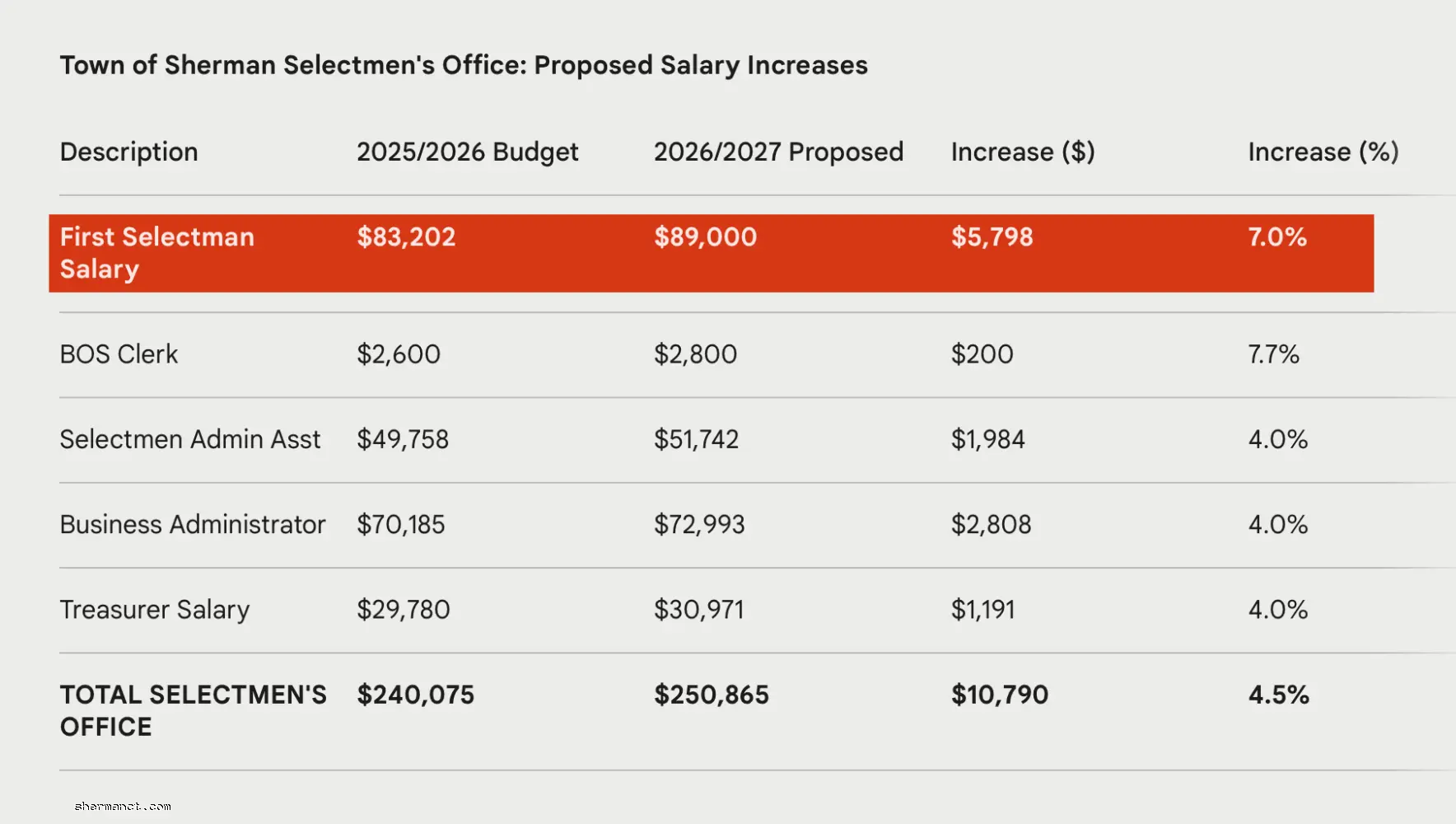
Instead, as you read further into the budget, this salary surge begins to look less like competitive compensation and more like a taxpayer-funded vehicle for personal financial rehabilitation. More than half of his entire office's proposed budget increase this year was routed directly into his own pocket. Meanwhile, the master ledger reveals that he allocated mere 4.0% raises to the administrative staff who actually run the day-to-day operations of the building.
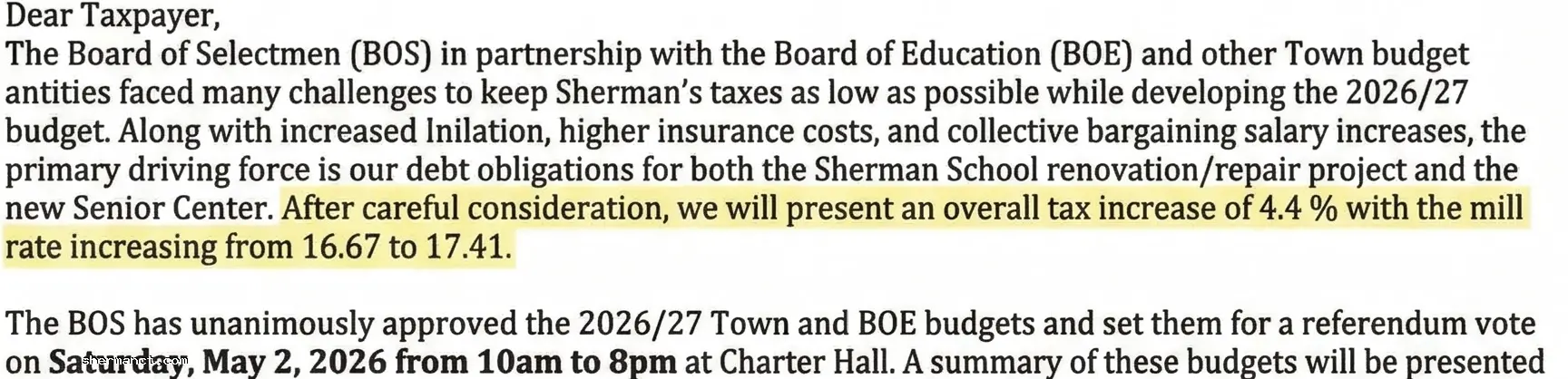
The First Selectman's personal raise dramatically outpaces inflation, eclipses his staff's compensation, and easily clears the 4.44% tax hike he is passing onto the residents. It is a textbook case of self-indulgent enrichment, austerity for the taxpayers and the staff, but a blank check for the corner office.
While multi-million dollar ledgers and administrative shell games paint a broad picture of municipal bloat, the true cost of Sherman’s budget is ultimately measured at the kitchen table. With the proposed mill rate climbing from 16.67 to 17.41, the tax burden on the median Sherman home, valued at approximately $664,500, is slated to jump by nearly $350 this year. But property values across our rural landscape vary wildly depending on lake proximity and acreage. We built the interactive ledger below so you can input your own home’s market value and instantly calculate exactly how much the First Selectman’s new budget will impact your personal bottom line.
The Sherman Tax Impact Calculator
Adjust the slider or enter your home's market value to see the real-time impact of the proposed 2026/2027 budget.
The $1.16 Million Illusion
The First Selectman’s compensation may be a matter of principle, but the town’s debt is a matter of sheer survival. As you flip to the back pages of the budget, a terrifying reality comes into focus: the massive spending spree on the Sherman School has officially come due. The town's Debt Service has exploded by an astronomical 95.7%, skyrocketing from $1.25 million last year to over $2.45 million this year.
How, then, did the administration manage to present a seemingly palatable 4.44% tax increase in their glossy mailer? They employed a massive, one-time sleight of hand. To preempt a taxpayer revolt, the town is quietly raiding its savings accounts, applying $1.16 million in surplus funds, $660,000 from the General Fund and $500,000 from the Bond Premium, to artificially suppress the mill rate.
It is a fiscal Band-Aid, not a structural solution. A municipality can only drain a surplus once. When that $1.16 million vanishes next year, the $2.45 million debt payments will remain, leaving taxpayers staring down the barrel of an unmasked, catastrophic tax hike.
The Approaching Storm: When the Band-Aid Peels Off
If you think a 4.44% tax increase is steep this year, take a close look at the town's long-term projections.
Sherman has enjoyed a decade of relative tax stability. But the $50 million school renovation project, and the resulting $32 million local bond required to pay for the town's share, has fundamentally altered Sherman's financial reality.
While the administration is using $1.16 million in surplus funds to artificially suppress the tax hike this year, that safety net is temporary. Once those reserves are drained, the full weight of the debt service will hit the taxpayers. According to the town's own approved Tax Impacts Summary, the mill rate is projected to steadily climb toward an 18.68 peak over the next few years.
This isn't a one-time blip; it is a structural transformation of what it costs to live in Sherman.
Disappearing Dogs and Creeping Cyber Costs
Keep scrolling through the ledger, and you begin to stumble across a series of bizarre administrative choices. Perhaps the most glaring cut belongs to Animal Control (Account 026-28), which plummeted from a $25,066 budget to absolute zero, a 100% reduction. A tiny, cryptic footnote simply dictates this is "To be paid from Dog fund." What exactly is this mysterious fund? Is the town quietly outsourcing or defunding a crucial service in a rural, animal-heavy community?
Simultaneously, the quiet "ransomware tax" of the modern era is steadily creeping upward. Town Hall IT Contracts (Account 017-22) are jumping 8.7% to $104,358 to cover network support, while municipal Liability Insurance (LAP) is ticking up 3.5% to $90,600. These creeping administrative costs are the hidden, inevitable price tags of digital vulnerability.
The DPW Contrast
In sharp contrast to the First Selectman's office, the Department of Public Works kept their day-to-day operating budget increase to a highly disciplined 2.6%. However, taxpayers should not look away from their capital requests. The DPW's capital expenditure plan reveals massive upcoming asks, including $250,000 for a new building addition and $140,000 for a new plow truck.
A budget is ultimately a moral document; it tells us exactly what an administration values. In Sherman, the glossy mailers tell a comforting story of conservative fiscal management. But the ledgers reveal a town heavily masking its debt, quietly rewarding its executives, and kicking a multi-million-dollar reckoning down the road.
Sources & Further Reading
- Sherman, Annual Budgets:2026-2027 Draft
- Sherman BOS BOF, Debt Service:2025-2026
Update: Administration Response
April 12, 2026
On Friday afternoon, Sherman CT News submitted a formal media inquiry to First Selectman Don Lowe, officially copied to the Town Clerk, specifically requesting comment on the 7.0% salary increase proposed for his position under Account 001-61.
The First Selectman was offered the opportunity to explain this specific line-item, particularly in light of the 4.0% raises given to the rest of his office staff and the 4.44% mill rate increase facing residents.
As of Sunday afternoon, First Selectman Lowe has declined to respond or provide any context for the taxpayers.
Sherman CT News remains open to publishing the First Selectman's unedited response should he choose to address the public regarding these ledgers.
Support Independent Journalism
Investigative journalism and detailed municipal reporting require an immense amount of time and resources. From the initial background research and public records requests to the painstaking data illustration and editing, producing these articles is a full-time commitment. If you value this level of independent reporting, please consider supporting the effort. Whether it's a few bucks or a generous contribution, every donation helps keep this project running.