The Second Act Economy
The Hidden Demographic Reality of Sherman, Connecticut

There is a powerful, almost hypnotic assumption about towns like Sherman, Connecticut. Nestled in Fairfield County and draped around the edges of Candlewood Lake, it presents as the quintessential, wealthy New England retirement enclave, a quiet place where successful professionals age gracefully out of the workforce, trade their commutes for the golf course, and live comfortably off meticulously managed portfolios.
But if you open the raw, publicly available census data and look closely at the demographic ledgers, that tranquil assumption violently shatters.
What emerges instead is a fascinating, almost cinematic portrait of a municipality defying conventional aging patterns. Sherman is currently functioning as the capital of the "Second Act Economy." It is a town where the traditional retirement has been quietly canceled, driven by unique household dynamics, a crushing cost of living, and an impending demographic cliff that no one is talking about.
The Demographic Mystery
The discovery begins with a single, undeniable fact: Sherman is the oldest town in Connecticut, boasting a median age of 58.2.
By The Numbers
Sherman's inverted demographic reality:
- 58.2 Years: The median age, making Sherman the oldest town in the state.
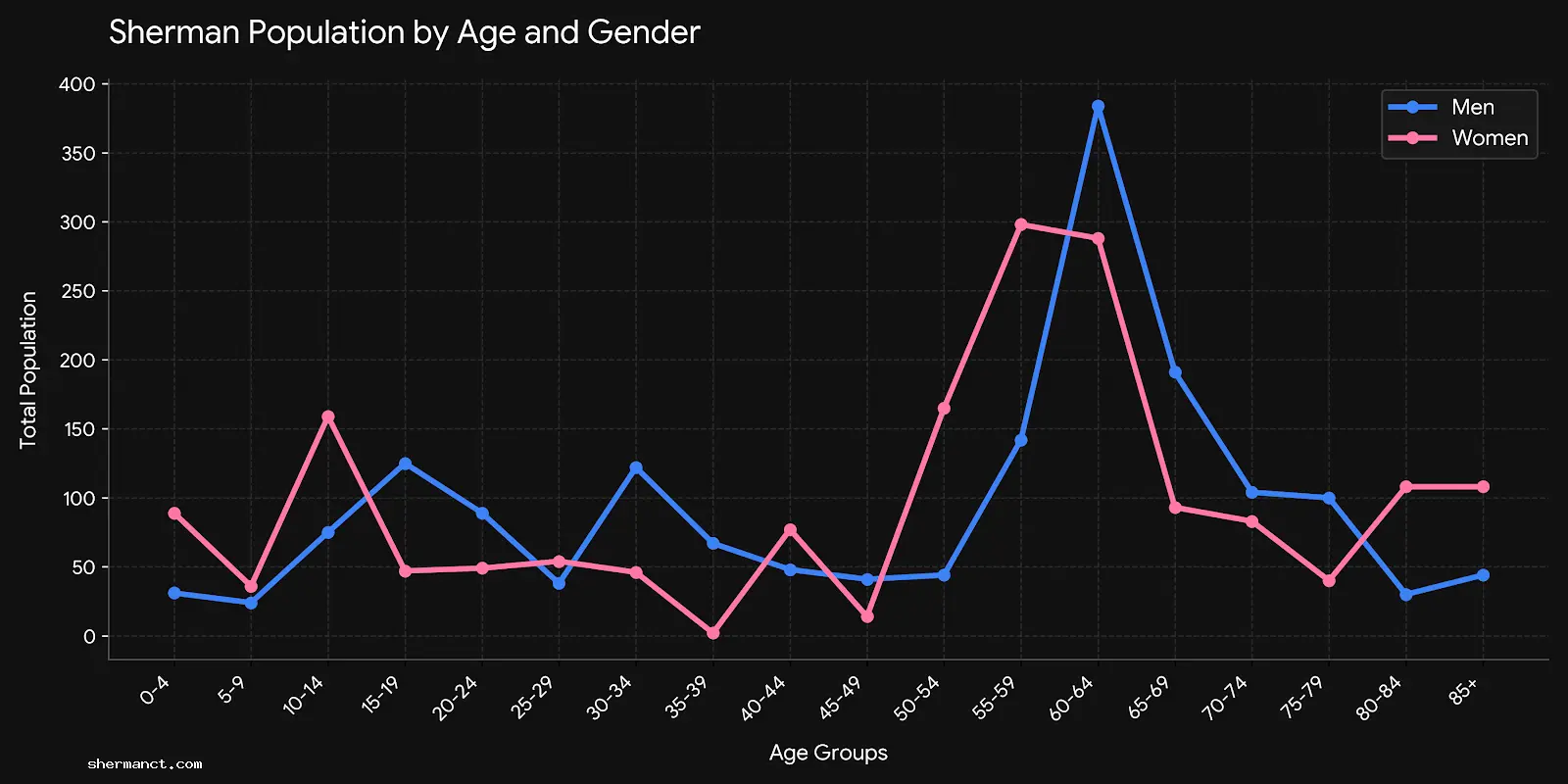
- 575 vs. 381: The staggering ratio of Men to Women in the 60-to-69 bracket.
- 697 vs. 275: The massive surplus of Women to Men a single generation down (40-to-59).
When examining aging populations, demographers expect to see a standard actuarial trend: because women naturally outlive men, older age brackets almost universally skew female. Yet, in Sherman, the data violently flips this standard on its head.
If you isolate the 60-to-69 age bracket, men outnumber women by a massive margin. According to recent census estimates, there are 575 men between the ages of 60 and 69, compared to just 381 women in that same bracket.
Are these the hills of lonely bachelors? Not quite. To solve the mystery, one only needs to look a single generation down. In the 40-to-59 age bracket, the gender ratio violently reverses. In that cohort, there is a staggering surplus of women, 697 women compared to a mere 275 men.
The mathematical takeaway is as unexpected as it is provocative. The data strongly points to Sherman operating as a haven for the "May-December" or "Second Act" marriage. The demographic makeup heavily suggests a localized trend of older men sharing households with significantly younger women.
The Hustle Never Ends
Once that localized human-interest angle takes hold, the brutal economic reality of sustaining that lifestyle sets in.
This localized grind is a microcosm of a much larger national crisis. As recently highlighted in Seniorly's *Best and Worst States to Retire in 2025* report, a record 4.2 million Americans will turn 65 this year into an economy that is entirely hostile to fixed incomes. The study notes that a staggering 61% of adults over 50 are terrified they will not have enough money to support themselves in retirement.
When you combine rising lifespans with the crushing cost of living in states like Connecticut, which shares the same brutal affordability metrics that dragged neighboring Massachusetts and New York to the absolute bottom of Seniorly's financial rankings, the traditional retirement math simply breaks down. For Sherman's older residents, staying in the workforce is the only way to bridge the gap.
For a quarter of our aging population, the gold watch is an illusion. The state's relentless affordability crisis, paired with their own unique household dynamics, demands that they keep earning well into their late sixties and seventies.
The Looming Crisis: The Empty Playground
As fascinating as the "Second Act" dynamic may be, tracing this data to its logical conclusion reveals a terrifying vulnerability for the town's future.
The most alarming statistic in Sherman isn't the high number of working seniors; it is the total, unprecedented absence of children. In the entire municipality, there are only 60 children between the ages of 5 and 9.
The Support Deficit
This hollowed-out youth population has left Sherman with a "potential support ratio" of just 2.4. This means there are barely more than two working-age adults available to systemically and financially support every single elderly resident.
The taxpayers of Sherman must inevitably ask themselves a devastating question: Who is going to pay the taxes to maintain the town's infrastructure when this massive, disproportionate bubble of working 60-something men finally ages out of the workforce or passes on?
There is no next generation moving in to replace them. The ledgers are crystal clear. Sherman is a town running on the borrowed time and extended labor of its oldest residents, sprinting toward a demographic cliff with no safety net in sight.
Sources & Further Reading
- Neilsberg Research:Sherman, Connecticut Population by Age
- Visual Capitalist:Mapped: Where Americans 65+ Are Still Working
- Connecticut Demographics:Sherman, CT Demographics
- City-Data:Sherman, Connecticut Profile & Statistics
- Retirement Best and Worst: #19 Connecticut
Support Independent Journalism
Investigative journalism and detailed municipal reporting require an immense amount of time and resources. From the initial background research and public records requests to the painstaking data illustration and editing, producing these articles is a full-time commitment. If you value this level of independent reporting, please consider supporting the effort. Whether it's a few bucks or a generous contribution, every donation helps keep this project running.