The Ultimate Wealth Filter
The Reality of Buying Real Estate in Sherman, Connecticut
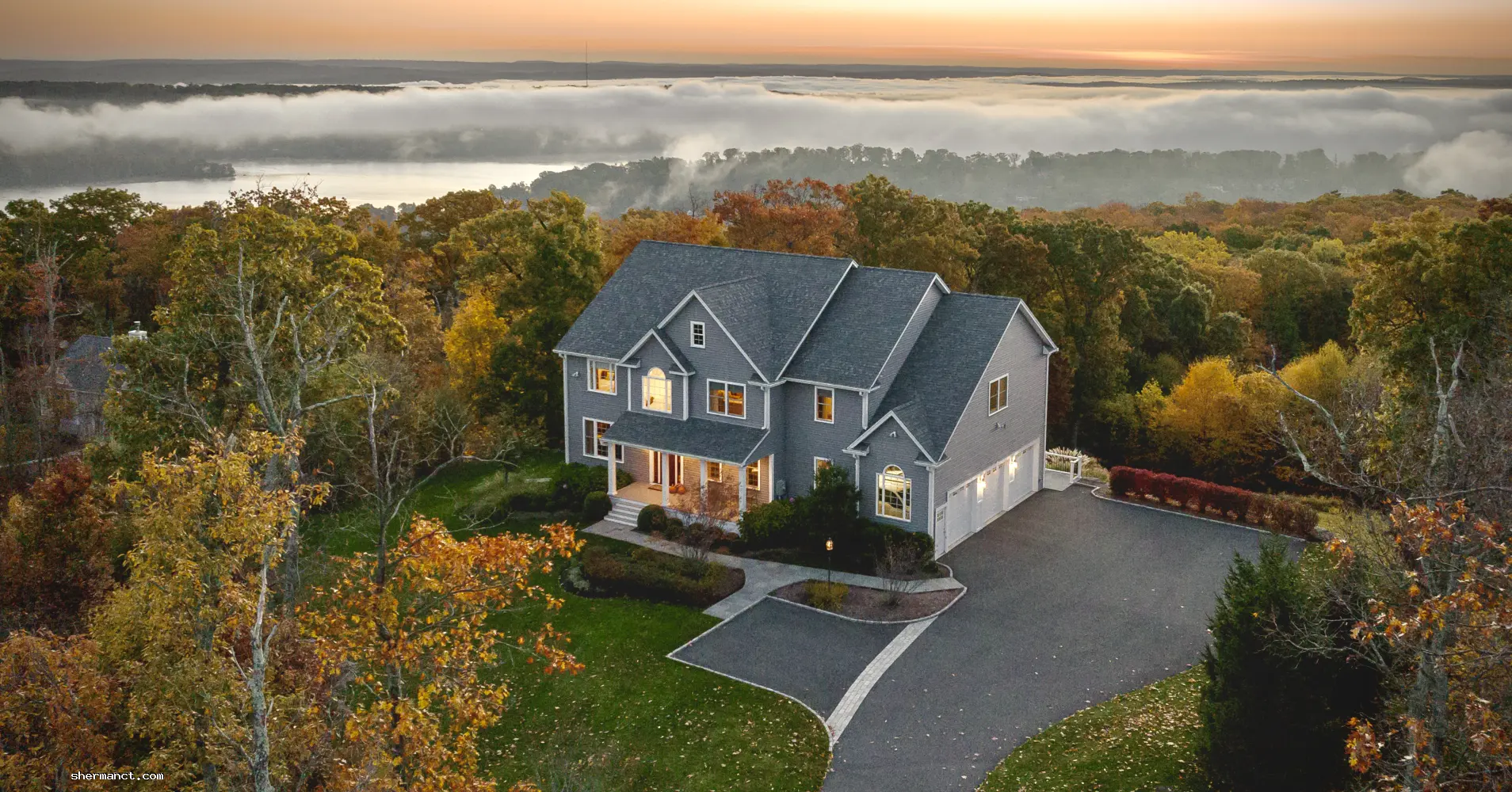
By the time you clear the commercial sprawl of New Milford and the commuter lots of Brewster, your cell service has already dropped to a single bar. The roads narrow. The elevation climbs. Suddenly, you are enveloped in a dense canopy of Connecticut green.
You have crossed into Sherman.
For an exhausted city dweller exploring the area for the first time, the appeal is immediate. With a population of fewer than 4,000 and a highly coveted "Rural Index of 2," the town feels like an isolated logging outpost in Vermont, yet it sits just 70 miles from Manhattan. As the spring real estate market heats up, you look at the properties—historic colonials, modern lakefronts, sprawling acreage—and it looks like a bucolic paradise.
But spend a little time here, and a quiet friction emerges. Beneath the idyllic New England surface lies a deeply engineered exclusivity.
The Missing Main Street
The first puzzle is the geography itself. Naturally, you look for the town center. You want to find that bustling, quintessential Main Street lined with an artisanal bakery, a boutique fitness studio, and a wine bar where the locals gather.
You won't find one.
Sherman has virtually no commercial footprint, and you quickly realize this isn't the result of a depressed economy. It is a feature, not a bug. The town relies on strict zoning laws to block commercial permits and storefronts. They do not want tourist traffic. They do not want strip malls. They do not want high-density housing. The locals are protective of their isolation, and the message to newcomers is clear: You are expected to adapt to Sherman's quiet. The town will not adapt to you.
The Ledger and the Demographic Filter
Intrigued by this guarded exclusivity, you sit down with a local real estate agent. They show you entry-level homes hovering around $800,000 and pitch the town's famously low taxes. It sounds like a financial haven.
Then, you look at the town ledger.
Those low taxes are an illusion, currently being erased by a $42.8 million renovation at the local Pre-K through 8th Grade elementary school. You look at the town's demographics and scratch your head: the median age of a Sherman resident is nearly 60 years old. It is a town of empty-nesters and retirees. Why is an aging population taxing itself to the brink for a sprawling grade school in a town that provides virtually zero other municipal services?

The answer is an exercise in administrative tunnel vision. The town desperately wants to sustain its real estate market, but because anti-development zoning keeps housing prices exceptionally high, the compounding tax hikes act as a highly effective wealth filter.
The result is a publicly funded private academy. In a rapidly diversifying state, the Sherman student body remains 83.5% White, with less than 1% identifying as Asian or Black, and exactly 0.0% reported as non-binary. It is a high-performing, socio-economically insulated bubble, paid for by retirees to keep the property values climbing.

The Illusion of the Water
Still taken by the landscape, you shift your gaze to the town's centerpiece: Candlewood Lake. Surely, a town this protective of its land has pristine water.
Instead, you discover the lake is a 1920s engineered power reservoir that spends its summers frequently choked by toxic blue-green algae blooms. The cause, it turns out, is the real estate itself. Built decades ago, grandfathered estates sit far too close to the water, their aging septic systems leaching nutrients directly into the lake.
Instead of addressing the existing infrastructure, the town shifts the burden to new buyers. While the old homes pollute the water, the current Sherman Sanitary Health Code makes breaking new ground a bureaucratic marathon. Want to build near the lake today? Prepare for a 200 horizontal-foot setback.
Think you are safe if you buy land slightly further inland? The Health Code dictates that no part of your septic system can be within 100 feet of the bank of any brook or stream, or within 50 feet of any defined wetland. Even if you own a previously approved lot where that 100-foot buffer is physically impossible, the town will only drop the requirement to 75 feet after putting you through a regulatory gauntlet. Before you can even pull a permit, you must dig 7-foot deep observation holes just to prove your soil percolation.
But the administration operates by a different set of rules for its own properties.
Look no further than the municipal and school parking lots. While a private citizen navigates months of red tape to install an ecologically clean septic system, the town allows its own asphalt runoff, laced with vehicle pollutants, to drain into a rudimentary crushed-rock structure that ultimately flushes right into the very lake they claim to be protecting.

The Price of the Canopy
If you survive the zoning and the soil tests, you finally realize that living under this canopy of old-growth trees comes with a steep carrying cost.
There are no municipal natural gas lines running through these woods. Heating a historic colonial through a bitter February requires a massive buried propane tank or regular deliveries of heating oil.
Furthermore, Connecticut consistently ranks among the top three most expensive states in the nation for electricity. When heavy winter ice storms hit, those beautiful trees take the power lines down with them. A standby whole-home generator isn't a luxury up here; it's mandatory. Between Eversource delivery rates and the fuel required to keep a house lit and warm, your energy carrying costs can easily rival a secondary mortgage.
The Ideological Frankenstein
As you piece it all together, the true nature of Sherman snaps into focus. It is not strictly a "red" town or a "blue" town. It doesn't subscribe to a single, coherent political platform.
Instead, Sherman operates on a highly customized ideology—a mix of conservative, liberal, Republican, and progressive values, applied only when it suits the town's old-world aesthetic and property values.
The town uses liberal conservation laws to limit new construction, not to actually protect the lake. It votes for progressive school funding, but uses it to preserve a homogeneous demographic. It outwardly projects modern democratic values, yet it relies on exclusionary zoning to ensure there is no low-income housing and no commercial job center. It is a town whose administrative contradictions keep it unapologetically stuck in the 1950s.

The Sanctuary
So, with the climbing taxes, the lack of municipal services, the utility costs, and the bureaucratic hypocrisy, why does anyone buy here?
Because when you finally accept the rules, pay the toll, and secure your piece of Sherman, the reward is undeniable.
To live here is to inhabit the charm of an undeveloped, traditional American town. The topography is a rolling sea of green hills. Because commercial zoning is so restricted, the land is dotted with small, active farms. In the summer, you can take a slow drive down a winding backroad and find neighbors offering fresh eggs, left on a roadside stand with nothing but a wooden lockbox for the honor system.

If you are looking to escape the relentless hum of big-city life, this is your sanctuary. If your goal is to disconnect, unplug your phone, and safely lean into your antisocial tendencies, there is no better refuge. You don't come here to be seen. You come here to disappear into a good book by a wood-burning stove, listening to the rain hit a tin roof, surrounded by hundreds of acres of protected woods.
It takes work to get here, it takes wealth to enter, and it takes resilience to stay. But for those who value privacy over convenience, there is simply nowhere else left like it.
Support Independent Journalism
Investigative journalism and detailed municipal reporting require an immense amount of time and resources. From the initial background research and public records requests to the painstaking data illustration and editing, producing these articles is a full-time commitment. If you value this level of independent reporting, please consider supporting the effort. Whether it's a few bucks or a generous contribution, every donation helps keep this project running.