A Question of Fairness: How Sherman’s Revaluation Targeted the Middle Class
Property taxes are going up. While overall rates remain low for Connecticut, the distribution of that new debt is wildly uneven.
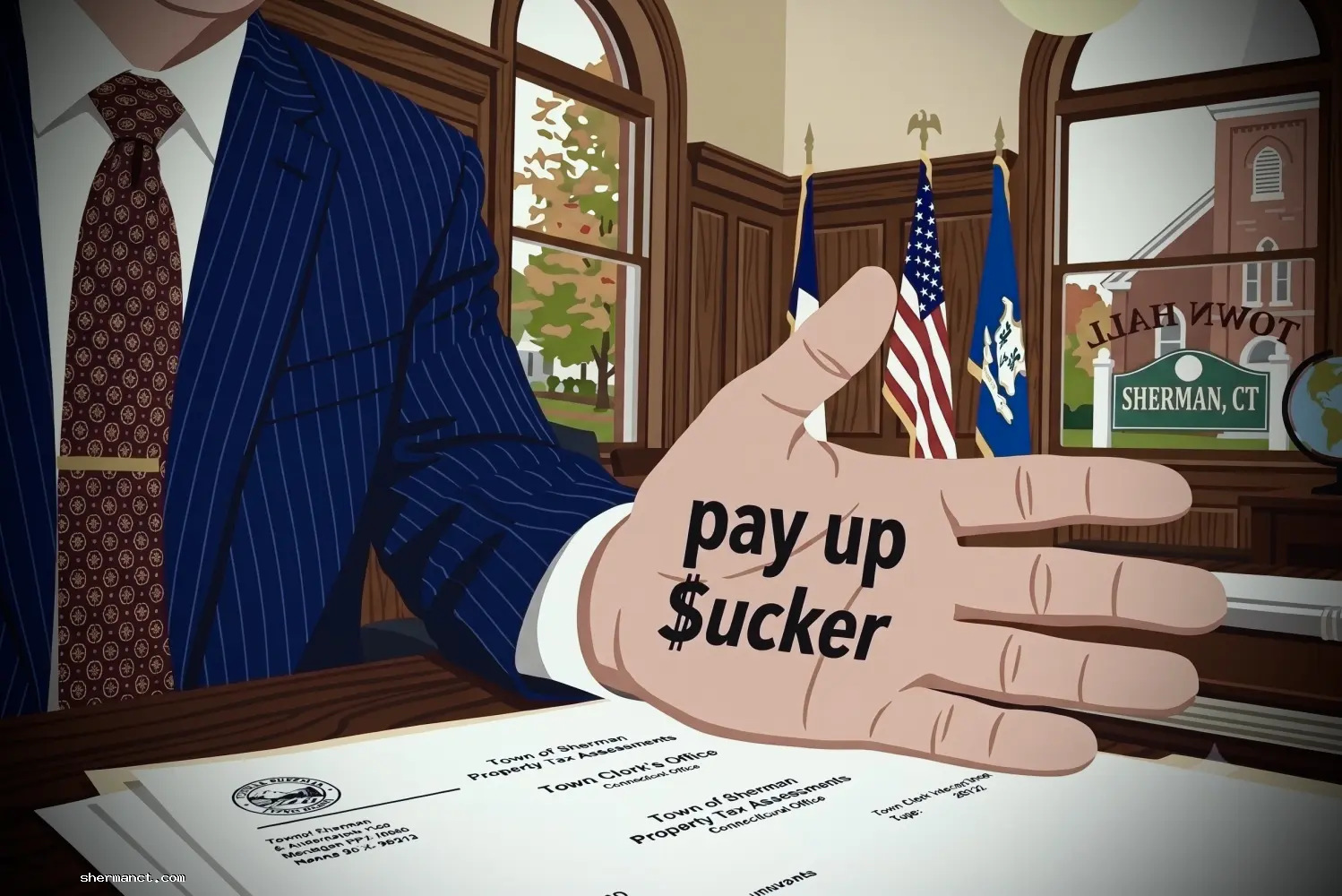
Let’s be honest about living in Sherman: even with the recent increases, our property taxes remain fairly low compared to virtually anywhere else in Connecticut. They should be, since we receive almost no municipal services. No one is truly being crushed into poverty by the mill rate alone. The frustration currently bubbling up across town isn’t just about the dollar amount attached to the $50 million school project or the length of the loan; it is about basic fairness. Part of the appeal of small-town life is leaving big-city political maneuvering behind. Yet, a close look at our latest tax distribution suggests those exact problems have quietly found their way into our isolated community. It seems we found yet another example of the administrator class dealing favors for the wealthy class, hoping the working class wouldn't notice. Well, we did.
Sherman CT News recently ran the town's digital database through an algorithmic check, going over the numbers with a fine-tooth comb. What we found is nothing short of startling in its plainness. The administration has essentially saddled the middle class with a highly disproportionate rate of the new tax burden to pay off the school debt while largely leaving upper-class estates alone. The data shows a steep upward trajectory for working families and a flat, undisturbed valuation line for those at the very top, which includes several senior municipal leaders.
The Data and the Disconnect
The rollout of these new assessments was remarkably clumsy. When residents tried to look up their field cards on the official third-party website, the system was riddled with errors or presented confusing, mixed metrics that made it difficult to understand true assessed values. We expect a fair tax system and we demand transparent reporting. When we log on to an official portal, we expect clean data, not selective miscalculations of some numbers while others remain hidden. This may be a small town but that doesn't mean municipal business should be done on construction paper with crayons. The people of Sherman expect a basic level of competence.


Right when citizens needed to access the town's public-facing field card portal to audit their new assessments, the same infrastructure where surrounding Connecticut towns host their property data, the database was fundamentally disabled. Users attempting to pull up their files at PropertyRecordCards.com were met with a persistent HTTP 500 Internal Server Error page, effectively shutting down public scrutiny at the exact moment the clock was ticking on their statutory right to appeal.
Simultaneously, the digital systems that remained functional were configured to display deceptive, mixed valuation metrics. The third-party interface hosted by J.F. Ryan Associates was set up to display 2022 market values at 100 percent directly alongside the 70 percent assessed values for 2023 without clear context. Anyone looking at the history table would naturally assume their baseline valuation dropped by roughly 30 percent, yet this is a complete administrative fiction. This juxtaposition created a powerful optical illusion, misleading homeowners into a false sense of security while their actual tax liabilities climbed underneath.
Financial Analysis: How Bad Is It, Really?
The Cash Extraction When we run the numbers, the Assessor artificially strapped $21,263,980 in excess valuation onto the backs of Sherman’s working families. Then we apply the Sherman 16.67 mill rate, the theoretical math becomes a hard cash penalty.
The Cost to the Middle Class:
- Annual Penalty: The middle class is being forced to pay an extra $354,470 in property taxes every single year.
- The 5-Year Cycle Cost: Before the next revaluation occurs, working families will be quietly drained of $1,772,352.
The Savings for the Upper Class:
Annual Wealth Protection:
The town's wealthiest estates are collectively saving $354,470 in property taxes every year.
The 5-Year Cycle:
The executive class will pocket $1.77 Million in uncollected taxes over the lifespan of the revaluation.
When a town is actively trying to underwrite a $50 million megaproject, a $1.77 million tax shift spread out over five years looks like a rounding error. The scandal isn't the sheer size of the dollar amount. It is the surgical precision of the extraction. The administration only needed to shift enough of the burden to perfectly insulate the town's most litigious, influential, and powerful residents from the financial fallout.
The Mathematical Improbability of the Administration's Assessments
To better understand how the recent property assessments affected town officials compared to the rest of the community, Sherman CT News ran a standard statistical analysis known as a Permutation Test.
- The Valuation Shift: We looked at a random sample of 100 town properties. The average residential property in this group saw a valuation increase of +19.24% during the recent reassessment. In comparison, a sample of 24 town administration officials saw their property valuations increase by an average of only +8.62%.
- Understanding the P-Value: In statistics, a "P-value" helps determine the likelihood that a specific result happened by pure chance. Generally, a P-value below 0.05 (5%) suggests that a pattern is not a random coincidence. To calculate the P-value here, our simulation tested thousands of random property combinations from our baseline to see how often a gap this wide occurs naturally.
The Results: The simulation returned an Empirical P-Value of 0.0004, which falls well below the standard 0.05 threshold. In practical terms, this indicates it is highly improbable that this discrepancy happened by chance. The data reveals a distinct pattern where town officials were largely insulated from the valuation spikes experienced by the broader public.
Breaking Down the Financial Impact
When we translate these percentages into dollars, the difference in valuation creates a noticeable financial divide. Based on the data, the average town official sees a projected comparative advantage of $2,022.61 over a five-year period when measured against the average resident in our sample.
| Group | Sample Size | Average Annual Tax Impact |
|---|---|---|
| Random Town Residents | 100 Properties | +$181.65 |
| Administration Officials | 24 Properties | -$222.87 |
| Net Financial Difference | $404.52 per year | |
The Five-Year Trajectory: When this annual net difference of $404.52 is carried across a standard five-year assessment cycle, the cumulative gap between the two groups becomes quite clear.
- The Resident Impact: An average resident from our random baseline faces an estimated $908.26 in additional property tax liabilities over the next five years.
- The Official Trend: Conversely, the lower valuation shifts for the average town official result in an estimated $1,114.35 reduction in property taxes over that same period.
- Total Effective Gap: By entirely avoiding the tax increases levied on the public while simultaneously securing reductions, the average administration official secures a total financial advantage of $2,022.61.
The Criminal Referral and Institutional Silence
Town officials will likely attempt to dismiss these mathematical disparities, framing their unusually low tax assessments as nothing more than shrewd real estate purchases. Yet, true to form, the administration’s response to formal inquiries and the data presented by Sherman CT News has been absolute silence. While a refusal to comment is not a legal admission of guilt, it sends an unmistakable message to the taxpayers. It strongly implies a localized awareness of these anomalies and a coordinated strategy to avoid addressing them on the record. This classic constructive denial, withholding public files and forcing transparency inquiries into prolonged bureaucratic bottlenecks, is not a routine administrative delay. It is an active evasion.
However, ignoring the data will not make it disappear. The systemic mishandling of this revaluation has officially triggered a formal referral to the State Attorney General's Criminal Division. Make no mistake, a comprehensive, state-level forensic analysis of the administration's internal assessment practices is now pending, shifting the venue of accountability from a compliant Town Hall to state prosecutors.
The End of the Honor System
This intense scrutiny is arriving precisely because the traditional safeguards of local democracy have completely collapsed. As these severe financial disparities come to light, the Sherman Republican Town Committee, the town's designated opposition party, remains entirely silent. Rather than demanding answers on behalf of the working-class families absorbing this tax shift, the Republican leadership has instead been seen posting social media photos enthusiastically high-fiving the First Selectman. This cozy, transactional dynamic reveals exactly how seriously the local political establishment treats its duty to the public.
For years, this administration has skated by on an honor system, operating with minimal transparency and zero genuine political pushback. That era of unchecked autonomy ends now. If the local political committees refuse to protect the public, the independent press will continue to document the administration's financial architecture. The data has been preserved, the audits are complete, and the evidence has been formally submitted. Now, we will see what the state Attorney General Chriminal Devision thinks. The Republican Party's Silence has been noted.
Support Independent Journalism
Investigative journalism and detailed municipal reporting require an immense amount of time and resources. From the initial background research and public records requests to the painstaking data illustration and editing, producing these articles is a full-time commitment. If you value this level of independent reporting, please consider supporting the effort. Whether it's a few bucks or a generous contribution, every donation helps keep this project running.