State Authorities Notified Following Algorithmic Review of Sherman Property Revaluations
Evidence packets documenting assessment disparities and public database errors submitted to the Connecticut Attorney General and Chief State’s Attorney.

The financial framework underlying Sherman's ongoing $50 million school renovation project has come under formal legal scrutiny following an algorithmic audit of municipal data. Property records reveal a starkly uneven distribution of the town's expanding debt liabilities. While property tax rates in Sherman remain low relative to Connecticut state averages, a data analysis indicates that recent assessment shifts in Oct 2023 disproportionately impacted middle-income homeowners while insulating upper-class luxury estates from corresponding increases.
A digital data extraction comparing the 2022 and 2025 Grand Lists reveals clear mathematical anomalies across wealth brackets. According to the database, the bottom 10 percent of properties by value received an average assessment increase of 21.5 percent, while the top 10 percent of luxury estates increased by only 7.8 percent. Furthermore, the analysis indicates that the personal properties of the Selectman and five other senior town officials experienced flat valuations, plateaus, or localized suppressions that run completely counter to the broader municipal trend.
Public Database Interruptions and Metric Discrepancies
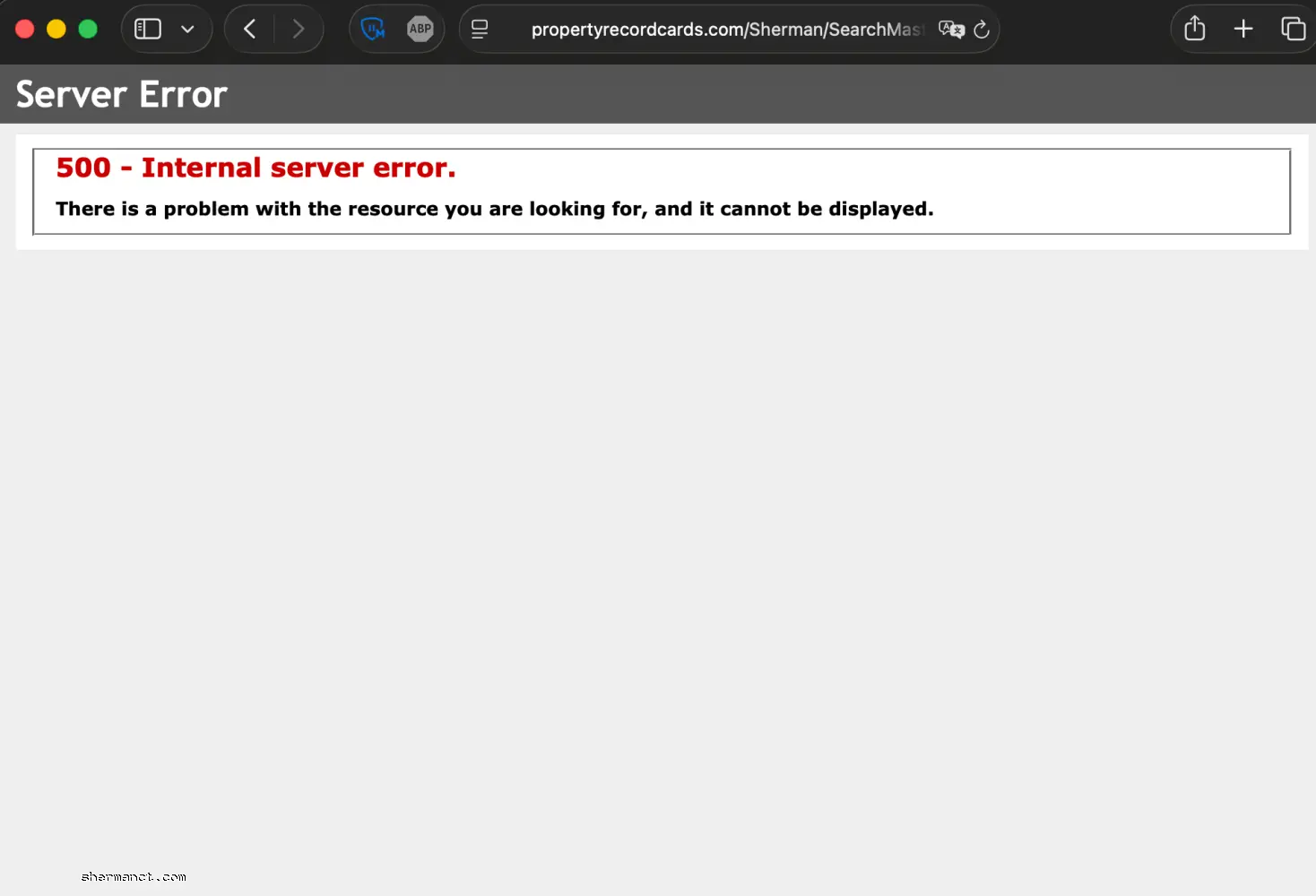
The operational rollout of the new assessments was marked by significant system interruptions. During the statutory window allocated for municipal tax appeals, the town's public-facing assessment portal at PropertyRecordCards.com became completely non-functional for Sherman queries, returning persistent HTTP 500 Internal Server Errors. This system failure effectively restricted residents from auditing their official property field cards before the state-mandated appeal deadlines elapsed.

Simultaneously, the secondary online system hosted by J.F. Ryan Associates displayed a mixed configuration of valuation metrics. The interface presented historical 2022 market values at 100 percent alongside the new 70 percent assessed values for 2023 without distinct contextual labels. This formatting gave the visual appearance of a 30 percent reduction in property value, masking the actual upward trajectory of individual tax liabilities and obscuring true taxpayer obligations during the active appeal phase.
Constructive Denials and Official Nondisclosure
Efforts to verify the source of these valuation discrepancies have faced institutional resistance. Public records requests submitted by Sherman CT News under the Freedom of Information Act sought the Computer-Assisted Mass Appraisal (CAMA) system audit logs and full property field cards. These specific system logs record the technical modifications, timestamps, and account IDs associated with any manual valuation changes made within the database.
Financial Analysis: How Bad Is It, Really?
The Cash Extraction When we run the numbers, the Assessor artificially strapped $21,263,980 in excess valuation onto the backs of Sherman’s working families. when we run $21.26 million valuation shift through Sherman's 16.67 mill rate, the theoretical math becomes a hard cash penalty.
The Cost to the Middle Class:
- Annual Penalty: The middle class is being forced to pay an extra $354,470 in property taxes every single year.
- The 5-Year Cycle Cost: Before the next revaluation occurs, working families will be quietly drained of $1,772,352.
The Savings for the Upper Class:
Annual Wealth Protection:
The town's wealthiest estates are collectively saving $354,470 in property taxes every year.
The 5-Year Cycle:
The executive class will pocket $1.77 Million in uncollected taxes over the lifespan of the revaluation.
When a town is actively trying to underwrite a $50 million megaproject, a $1.77 million tax shift spread out over five years looks like a rounding error. The scandal isn't the sheer size of the dollar amount. It is the surgical precision of the extraction. The administration only needed to shift enough of the burden to perfectly insulate the town's most litigious, influential, and powerful residents from the financial fallout.
The municipal administration has chosen not to fulfill these requests, resulting in a constructive denial. By withholding the underlying system logs from public view, the town has effectively locked the audit trails that would detail any manual overrides applied to the properties of senior municipal leaders, blocking external validation of the Grand List's integrity.
The Mathematical Improbability of the Administration's Assessments
To better understand how the recent property assessments affected town officials compared to the rest of the community, Sherman CT News ran a standard statistical analysis known as a Permutation Test.
- The Valuation Shift: We looked at a random sample of 100 town properties. The average residential property in this group saw a valuation increase of +19.24% during the recent reassessment. In comparison, a sample of 24 town administration officials saw their property valuations increase by an average of only +8.62%.
- Understanding the P-Value: In statistics, a "P-value" helps determine the likelihood that a specific result happened by pure chance. Generally, a P-value below 0.05 (5%) suggests that a pattern is not a random coincidence. To calculate the P-value here, our simulation tested thousands of random property combinations from our baseline to see how often a gap this wide occurs naturally.
The Results: The simulation returned an Empirical P-Value of 0.0006, which falls well below the standard 0.05 threshold. In practical terms, this indicates it is highly improbable that this discrepancy happened by chance. The data reveals a distinct pattern where town officials were largely insulated from the valuation spikes experienced by the broader public.
Breaking Down the Financial Impact
When we translate these percentages into dollars, the difference in valuation creates a noticeable financial divide. Based on the data, the average town official sees a projected comparative advantage of $2,022.61 over a five-year period when measured against the average resident in our sample.
| Group | Sample Size | Average Annual Tax Impact |
|---|---|---|
| Random Town Residents | 100 Properties | +$181.65 |
| Administration Officials | 24 Properties | -$222.87 |
| Net Financial Difference | $404.52 per year | |
The Five-Year Trajectory: When this annual net difference of $404.52 is carried across a standard five-year assessment cycle, the cumulative gap between the two groups becomes quite clear.
- The Resident Impact: An average resident from our random baseline faces an estimated $908.26 in additional property tax liabilities over the next five years.
- The Official Trend: Conversely, the lower valuation shifts for the average town official result in an estimated $1,114.35 reduction in property taxes over that same period.
- Total Effective Gap: By entirely avoiding the tax increases levied on the public while simultaneously securing reductions, the average administration official secures a total financial advantage of $2,022.61.
Submission of Evidence to State Prosecutors
Because local administration officials failed to provide transparency or release the underlying database logs, comprehensive evidence packets have been formally delivered to state authorities. Independent investigators have bypassed the municipal deadlock by submitting native data dumps, verified portal error logs, and FOIA non-compliance records directly to the Criminal Division of the Connecticut Attorney General and the Chief State’s Attorney for formal state-level review.
First Selectman Don Lowe and the Assessor's Office were served with a formal request for comment at 4:00 PM yesterday detailing these specific mathematical variances, the public database outages, and the withholding of CAMA audit files. Both offices missed the 9:00 AM press deadline and declined to provide a mathematical explanation for the localized valuation drops. A comprehensive state-level forensic analysis of the administration's internal assessment practices is now pending.
Support Independent Journalism
Investigative journalism and detailed municipal reporting require an immense amount of time and resources. From the initial background research and public records requests to the painstaking data illustration and editing, producing these articles is a full-time commitment. If you value this level of independent reporting, please consider supporting the effort. Whether it's a few bucks or a generous contribution, every donation helps keep this project running.