A Mayor’s Election, a Board’s Incompetence, and an Auditor’s License: The Standoff in Sherman
How a routine maintenance account became a quiet repository for capital construction overruns, and why nobody in Town Hall is willing to fix it.

There is a quiet crisis unfolding within the ledgers of Sherman’s $50 million school building project. The financial records, currently being finalized for the fiscal year, are materially incorrect. A staggering amount of money, approximately $281,000 in sole-source capital construction costs, has been improperly buried within a routine Board of Education maintenance account.
The misallocation likely began as a genuinely clumsy clerical error. However, pulling the truth into the light took months, and the resulting scrutiny only exposed a series of even clumsier errors made during the cover-up and subsequent attempts at a correction. Now, rather than taking decisive action to balance the ledger, the responsible parties are simply sitting on their hands, hoping the townspeople will eventually lose interest and look away. In the meantime, the school’s operating budget remains artificially inflated, securing a quiet, compounding pool of unallocated taxpayer funds that will roll over year after year.
What makes this administrative paralysis so toxic is that it is no longer just about avoiding embarrassment over a bookkeeping mistake. The true crisis facing the town is the three-way political standoff actively preventing the correction. The administration is currently trapped in an insidious triangle of liability, where the survival of one party essentially guarantees the destruction of another.
The Anatomy of the Misallocation
The financial mechanics of this maneuver are brazen. A routine maintenance sub-account, originally budgeted for roughly $14,675, suddenly ballooned, carrying more than $318,000 in actual and encumbered expenses. This represents a more than twenty-fold overrun, occurring precisely at a time when the Board of Education publicly promised that repairs and maintenance costs would decrease.
When you examine the invoices, the nature of these "maintenance" expenses becomes clear. According to correspondence submitted to town officials, the charges include $192,573 in sole-source plumbing contracts for the installation of hydronic heating zones, massive 3-inch supply lines, and the relocation of water services. Another $80,000 was directed to a sole-source contractor for the construction of demising walls and mechanical rooms. These are not the costs of fixing a leaky faucet or replacing lightbulbs. These are major capital construction expenses incurred because of the building project, and they have been quietly shifted onto the education operating budget.
The First Selectman’s Calculus
As the town's chief executive, First Selectman Don Lowe possesses the immediate authority to demand a forensic reconciliation of these accounts. While the Board of Education manages its own ledger, the First Selectman commands the executive platform to force transparency, halt the misallocation of municipal funds, and order the auditor to intervene. Yet, he refuses to act because of basic political calculus.
| Official | Board of Education | Democratic Town Committee (DTC) |
|---|---|---|
| Kate Frey | Board Vice Chair | Chairman |
| Matt Vogt | Board Chair | Vice Chairman |
| Tim Laughlin | Board Member | Treasurer |
| Maryanne Febbraio | Board Member | — |
| Kristin Grasseler | Board Member | — |
| Ryan McGlinchey | Board Member | — |
| James Philipakos | Board Member | — |
| Dr. Patricia Cosentino | Superintendent | — |
| Chris McDermott | — | Deputy Treasurer |
| Marie Mennonna | — | Secretary |
The Board of Education officials responsible for the misallocation also control the local Democratic Town Committee.
As an unnamed source closely monitoring the town's finances noted in correspondence with Sherman CT News, "Don is coming up for re-election and the Democratic BOE members control the Democratic Town Committee... and he is likely to be primaried. He will avoid confrontation with them at any cost to keep his job."
If the First Selectman exposes their financial incompetence by forcing a public correction, they possess the political leverage to end his tenure. He is actively trading the fiduciary integrity of a $50 million project to secure his own re-election.
Conversely, the Board of Education relies entirely on the First Selectman’s silence. If the administration does not absorb the public outrage and stonewall transparency requests, the school officials will be forced to answer for hiding construction overruns in the education budget. They desperately require the executive branch to act as a shield for their accounting failures.
The Auditor's Path of Least Resistance
This manufactured silence is highly unstable, primarily because it has dragged an independent third party into the fray. In written correspondence, a concerned taxpayer formally demanded that the town's auditor, David Cappelletti of Clermont & Associates, review these specific misallocations during the fiscal close-out process.
However, rather than stepping in to correct the ledger, the auditor appears to be providing the administration with convenient cover. The First Selectman has reportedly leaned on the technicality that these construction charges could legally be absorbed by the Board of Education's general fund because the funds were legally appropriated. As an unnamed source monitoring the situation noted, the auditor is likely avoiding confrontation since there is no strict illegality involved in the maneuver. By confirming that the town is legally permitted to hide capital construction costs inside a routine school maintenance account, the auditor is taking the path of least resistance. He isn't risking his license; he is simply enabling a terrible accounting practice to help the administration avoid a political crisis.
The Erasure of Transparency
As the scrutiny intensifies, the public record is quietly disappearing. At precisely the moment when transparency is paramount, the Board of Education launched a redesigned website. The Board of Education has removed public access to historical meeting agendas, minutes, and the crucial monthly budget status reports that first revealed the maintenance-account overruns.
Every official involved in this $50 million project currently has something devastating at stake. Correcting the ledger implicates the school board. Exposing the school board risks the First Selectman's seat. Protecting the First Selectman risks the auditor’s professional survival.
Sherman’s taxpayers have been left to underwrite a paralyzed administration. The town is watching a triad of desperate officials trying to decide who will ultimately take the fall. The administration’s policy of continued silence will not lead to political survival. Instead, it is actively pouring the concrete for the sarcophagus in which this administration's legacy will be buried.
Manufactured Burden
Faced with mounting inquiries, the administration's default posture has shifted from silence to bureaucratic deflection. When pressed for a timeline on fulfilling outstanding Freedom of Information requests, First Selectman Lowe refused to provide one, lamenting the “time and dollars” these inquiries cost the town. Instead, he challenged Sherman CT News to take the matter to the state level, writing he would be "more than happy to meet in person with the FOI Commission."
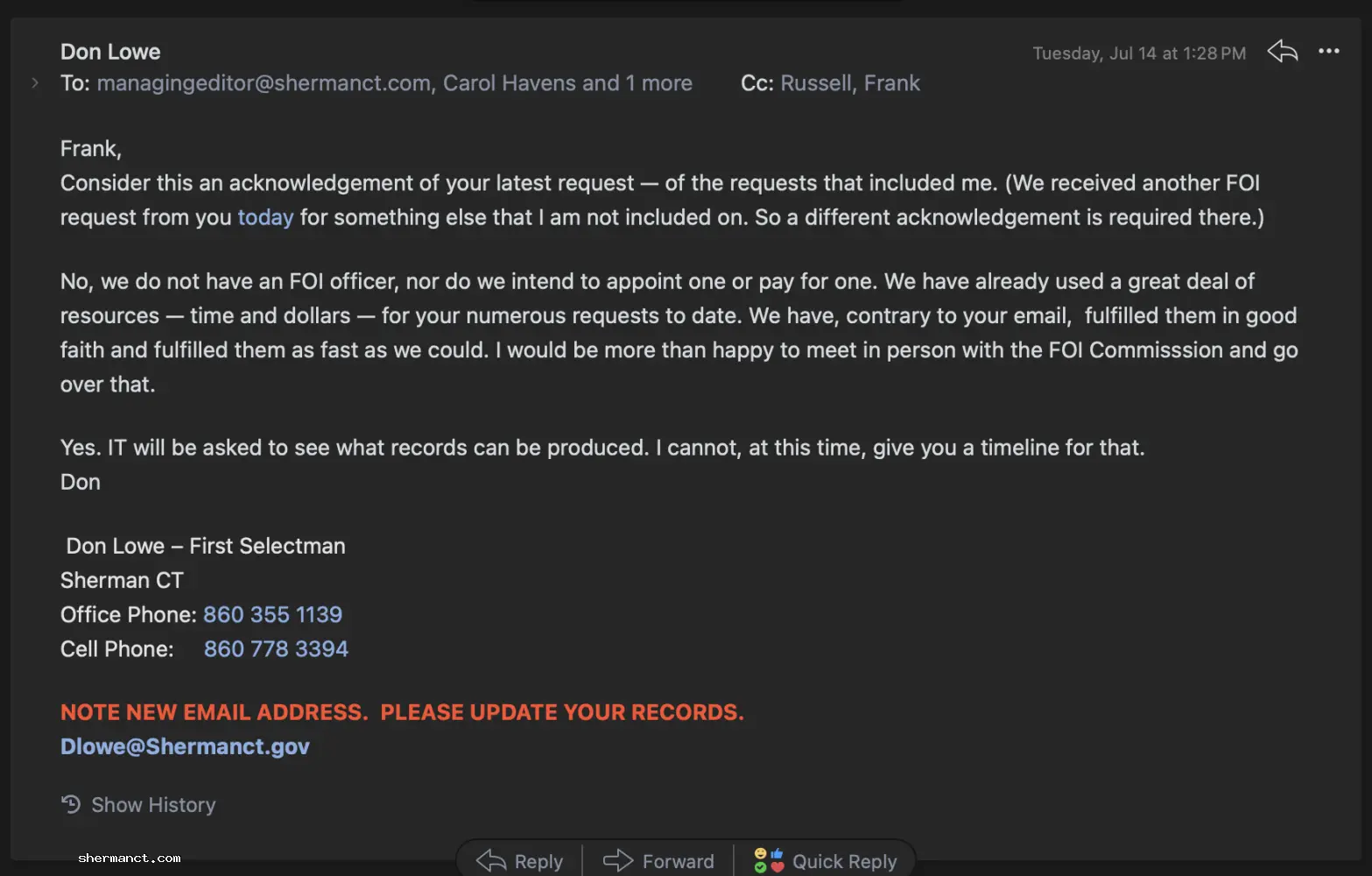
What the First Selectman failed to mention is that this intervention is already underway.
The state has already assigned docket numbers to two outstanding complaints born directly from the town's failure to comply with statutory response deadlines. To provide context for this alleged burden, it is necessary to examine the actual volume of inquiries. Between February 11 and July 24, the administration received precisely 12 Freedom of Information requests. Spread over nearly half a year, this averages out to approximately two requests per month, or roughly one every other week.
Characterizing a bi-weekly request for standard public documents as an overwhelming drain on municipal resources is statistically absurd. Furthermore, the records requested are neither obscure nor overly complex. They consist of foundational municipal data: town grand lists, property field cards, suppressed BOS Meeting minutes, and standard invoices for municipal projects.
When a town government claims that producing basic property and tax records twice a month constitutes a crisis, it raises a glaring question of administrative competence. In an era of digitized municipal accounting, producing a project invoice should require little more than a few keystrokes.
If fulfilling a bi-weekly public inquiry genuinely overwhelms the administration, it points to a staggering operational failure in Sherman's record-keeping. If it does not, then the cited "burden" is merely a fabricated shield designed to delay accountability and obscure the math behind a $50 million infrastructure project. Taxpayers are left to wonder which scenario is worse, and why their local leadership is willing to invite state-level litigation simply to avoid releasing a public invoice.
The Aggressor’s Victimhood
When pressed on fiscal discrepancies, the First Selectman’s public strategy escalated into civic shaming. The timing of this pivot is critical. On July 10, Sherman CT News published a report detailing the escalation of the town's financial and transparency failures to state regulatory authorities. In the immediate wake of that publication, Selectman Lowe used his official column to lament letting “a couple of people and their negative actions against the town weigh heavy on me.”

This column represents a documented, textbook example of political inversion. By attempting to reframe an investigation into a $50 million building project as an attack on the community itself, the administration sought to hide an indefensible accounting practice behind the goodwill of Sherman’s local volunteers.
More troublingly, the First Selectman’s self-portrayal as a beleaguered victim directly contradicts the administration's established reputation for retribution. Former municipal officials and residents have repeatedly warned of the executive branch’s vindictive culture. Local figures have characterized the administration as fundamentally "angry," another individual has described their operational tactics as "retaliatory."
Those descriptions align with a documented pattern of administrative hostility directed at both town volunteers and the press. This pattern ranges from passive-aggressive attacks levied against commission members, experienced firsthand by this reporter during his tenure on the Inland Wetlands Commission, to the overt weaponization of state and federal authorities. In response to routine journalistic inquiries, the executive branch has previously levied baseless accusations of criminal conduct, dispatched local law enforcement to this reporter's residence, and initiated unfounded FAA investigations. At no point during any of these retaliatory escalations was a single local ordinance, state law, or federal regulation broken.
When a municipal administration actively deploys police and federal agencies to intimidate the press, its leader cannot credibly claim to be the victim of "negative actions." True municipal leadership requires answering for the public treasury. When previously questioned about his ever-increasing executive salary, Lowe defended the compensation hikes by arguing that a higher salary would inevitably bring competition for his seat.
In a profoundly roundabout way, the First Selectman was absolutely right.
Escalating compensation demands escalating accountability, and that accountability has now arrived in the exact form he tried to suppress: rigorous, independent journalism. By prioritizing his own political survival over the fiduciary integrity of the town, Lowe has severely damaged his executive reputation. The irony of this standoff is inescapable. The administration’s refusal to correct a $281,000 accounting error out of fear of a primary challenge has manufactured the exact environment of public distrust that invites the very competition he predicted.
Sources & Further Reading
- FOIA Documents:March 2026 Sequestered BOS & Missing Budget Workshop minutes
- FOIA Documents:BOE Repairs & Maintenance Invoices & Purchase Orders
- Sherman School Board [Deleted]Agendas & Minutes
Update: Administration and Board of Education Response
July 24, 2026
On Thursday, July 23, Sherman CT News submitted formal press inquiries to First Selectman Don Lowe, Liz LaVia, Town Auditor David Cappelletti, and Board of Education members Matt Vogt, Tim Laughlin, and Kate Frey.
The officials were offered the opportunity to provide on-the-record clarification regarding the $281,259 in sole-source school construction expenses charged directly to a $14,675 BOE routine maintenance account, the resulting inflation of the education budget baseline, and the abrupt removal of historical budget reports and meeting minutes from the redesigned Board of Education website.
Despite being given a deadline of Friday, July 24 at the close of business, all officials chose absolute silence and declined to address these documented discrepancies or account for taxpayer funds to the public.
Sherman CT News remains committed to transparency and will publish their unedited responses in full should they choose to address the public regarding these findings.
Support Independent Journalism
Investigative journalism and detailed municipal reporting require an immense amount of time and resources. From the initial background research and public records requests to the painstaking data illustration and editing, producing these articles is a full-time commitment. If you value this level of independent reporting, please consider supporting the effort. Whether it's a few bucks or a generous contribution, every donation helps keep this project running.